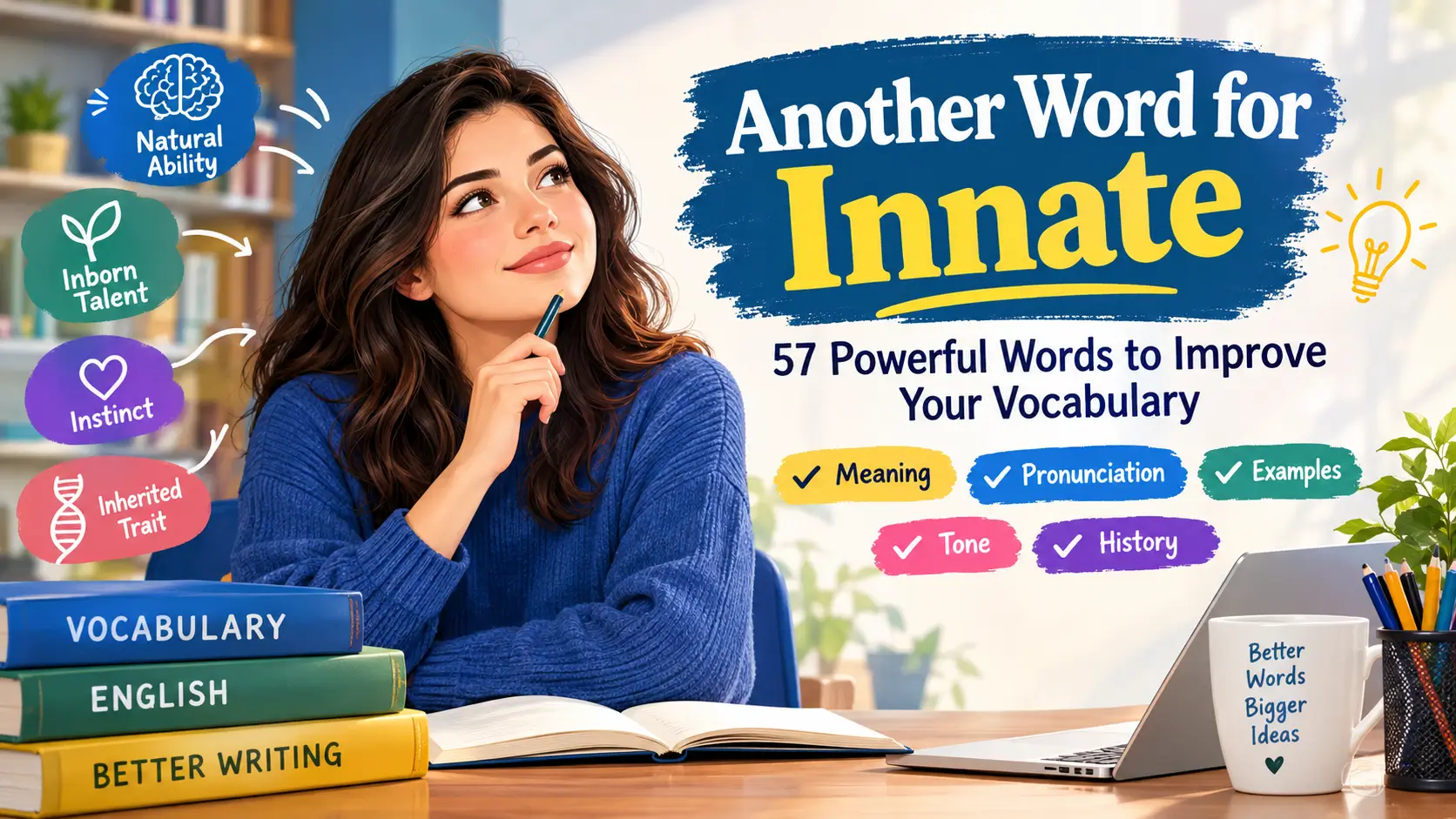
Another Word for Innate 57 Powerful Words to Improve Your Vocabulary
The word innate means something that a person has from birth or naturally possesses. For example, a child may have an innate ability to draw, sing, or understand how others feel. The child may improve these skills with practice, but the natural talent is already there.
People often use innate when talking about natural abilities, human behavior, feelings, qualities, and instincts. It is a useful word in education, psychology, science, and everyday writing.
Learning synonyms for innate helps English learners understand small differences between words and express ideas more clearly. It also helps content writers avoid repeating the same word. Some synonyms describe abilities present from birth, while others focus on natural qualities, instincts, or inborn traits.
In this guide, you will learn the meaning, pronunciation, history, grammar, and connotation of innate. You will also explore 57 synonyms, their meanings, example sentences, and the best situations in which to use them.
Meaning of Innate
Definition
Innate (adjective): A quality, ability, or feeling that a person or animal has naturally from birth rather than learning it later.
Examples
- The child has an innate talent for music.
- Humans have an innate need for connection and care.
Connotative Meaning
(Connotation is the feeling or idea that a word suggests beyond its basic meaning.)
- Positive tone: Innate can suggest natural talent, wisdom, kindness, or an impressive ability.
- Negative tone: It can describe an unwanted natural tendency, such as an innate fear or an innate weakness.
- Neutral tone: It can describe a natural quality or ability without praise or criticism, such as an innate response to danger.
Etymology
- Source language: Latin.
- Latin root: Innatus, meaning “born in” or “inborn.”
- Word parts: The word comes from Latin in- (“in” or “into”) and natus, related to nasci (“to be born”).
- Core idea: Something innate belongs to a person or living thing naturally rather than being gained through teaching or experience.
Short History of the Keyword
- Old English (450–1100): English had other ways to express the idea of something natural or present from birth. The modern word innate was not a regular part of Old English vocabulary.
- Middle English (1100–1500): Latin and French influenced English vocabulary, especially in education, philosophy, and religion. The Latin idea of being born with a quality helped shape later English use.
- Modern English (1500–Present): Innate became established as a word for natural qualities and abilities. It is now common in psychology, biology, philosophy, and everyday speech.
Pronunciation (US & UK – IPA)
Pronunciation
1×PlayStop
innate
/ɪˈneɪt/
Add to flashcards
Give feedback
- US: /ɪˈneɪt/
- UK: /ɪˈneɪt/
Syllables
in-nate — 2 syllables.
The stress falls on the second syllable.
Affixation Pattern of Innate
- Root: nat, connected to the Latin idea of birth.
- Prefix: in-, part of the word’s historical Latin formation.
- Suffix: No productive English suffix is added to form the modern word innate.
- Word formation: Innate is an adjective derived from Latin. Its English forms and related words include:
- Innately (adverb): In a natural or inborn way.
- Innateness (noun): The state or quality of being innate.
- Innate (adjective): Present naturally from birth or inherent in a person or thing.
- Innatism (noun): The philosophical view that some ideas or knowledge are inborn.
- Innativism (noun): A theory that some mental abilities or knowledge are inborn.
Synonyms of Innate
The following 57 words can replace innate in some contexts. However, they do not all mean exactly the same thing. Words such as inborn and congenital focus on birth, while inherent and intrinsic describe qualities that belong naturally to something.
1. Inborn (Adjective)
US IPA: /ˈɪnˌbɔrn/ | UK IPA: /ˈɪnˌbɔːn/
Meaning: Present from birth rather than learned later.
Examples:
- She has an inborn love of music.
- His inborn talent became clear at an early age.
2. Inherent (Adjective)
US IPA: /ɪnˈhɪrənt/ | UK IPA: /ɪnˈhɪərənt/
Meaning: Naturally belonging to a person, thing, or situation.
Examples:
- Every job has inherent risks.
- Patience is an inherent part of her character.
3. Intrinsic (Adjective)
US IPA: /ɪnˈtrɪnsɪk/ | UK IPA: /ɪnˈtrɪnsɪk/
Meaning: Belonging naturally to something rather than coming from outside it.
Examples:
- Every person has intrinsic worth.
- The task has intrinsic value beyond its reward.
4. Natural (Adjective)
US IPA: /ˈnætʃərəl/ | UK IPA: /ˈnætʃərəl/
Meaning: Existing or happening without being taught or forced.
Examples:
- She has a natural gift for painting.
- He showed a natural interest in science.
5. Instinctive (Adjective)
US IPA: /ɪnˈstɪŋktɪv/ | UK IPA: /ɪnˈstɪŋktɪv/
Meaning: Done or felt automatically without conscious thought.
Examples:
- Her instinctive reaction was to help.
- The child made an instinctive move toward safety.
6. Intuitive (Adjective)
US IPA: /ɪnˈtuːɪtɪv/ | UK IPA: /ɪnˈtjuːɪtɪv/
Meaning: Based on an immediate understanding without careful reasoning.
Examples:
- She has an intuitive sense of what people need.
- His intuitive judgment helped solve the problem.
7. Native (Adjective)
US IPA: /ˈneɪtɪv/ | UK IPA: /ˈneɪtɪv/
Meaning: Naturally belonging to a place or, in some contexts, present from birth.
Examples:
- She has a native ability to understand patterns.
- His native talent for storytelling impressed the class.
8. Congenital (Adjective)
US IPA: /kənˈdʒɛnɪtəl/ | UK IPA: /kənˈdʒɛnɪtəl/
Meaning: Present at birth, especially when describing a physical or medical condition.
Examples:
- The doctor explained the congenital condition.
- Some congenital traits can be identified at birth.
9. Genetic (Adjective)
US IPA: /dʒəˈnɛtɪk/ | UK IPA: /dʒəˈnɛtɪk/
Meaning: Related to genes or inherited biological traits.
Examples:
- Researchers studied the genetic basis of the trait.
- Genetic factors can affect eye color.
10. Hereditary (Adjective)
US IPA: /həˈrɛdəˌtɛri/ | UK IPA: /hɪˈrɛdɪtəri/
Meaning: Passed from parents to children through genes.
Examples:
- The family discussed its hereditary condition.
- Some hereditary traits appear across generations.
11. Inherited (Adjective)
US IPA: /ɪnˈhɛrɪtɪd/ | UK IPA: /ɪnˈherɪtɪd/
Meaning: Received from parents or earlier generations through genes or other forms of inheritance.
Examples:
- She inherited her mother’s eye color.
- The inherited trait appeared in several family members.
12. Constitutional (Adjective)
US IPA: /ˌkɑnstəˈtuːʃənəl/ | UK IPA: /ˌkɒnstɪˈtjuːʃənəl/
Meaning: Relating to a person’s basic physical or mental makeup.
Examples:
- He has a constitutional tendency to be lean.
- The study examined constitutional differences among participants.
13. Innately Present (Adjective Phrase)
US IPA: /ɪˈneɪtli ˈprɛzənt/ | UK IPA: /ɪˈneɪtli ˈprezənt/
Meaning: Existing naturally rather than developing through learning.
Examples:
- Some responses may be innately present.
- The researchers asked whether the ability was innately present.
14. Hardwired (Adjective)
US IPA: /ˈhɑrdˌwaɪərd/ | UK IPA: /ˈhɑːdˌwaɪəd/
Meaning: Built into a system or strongly natural in behavior.
Examples:
- The brain has hardwired responses to some threats.
- Humans may have a hardwired drive to seek safety.
15. Built-In (Adjective)
US IPA: /ˌbɪlt ˈɪn/ | UK IPA: /ˌbɪlt ˈɪn/
Meaning: Naturally included as part of something.
Examples:
- The body has built-in ways to protect itself.
- The device has a built-in safety feature.
16. Ingrained (Adjective)
US IPA: /ɪnˈɡreɪnd/ | UK IPA: /ɪnˈɡreɪnd/
Meaning: Deeply fixed in a person’s habits, beliefs, or behavior.
Examples:
- Respect was an ingrained part of her upbringing.
- The habit became ingrained over many years.
Usage note: Ingrained qualities may develop through experience, so the word is not always a direct synonym for innate.
17. Deep-Seated (Adjective)
US IPA: /ˌdiːp ˈsiːtɪd/ | UK IPA: /ˌdiːp ˈsiːtɪd/
Meaning: Strongly established and difficult to change.
Examples:
- He had a deep-seated fear of failure.
- The team worked to address deep-seated doubts.
18. Unlearned (Adjective)
US IPA: /ʌnˈlɜrnd/ | UK IPA: /ʌnˈlɜːnd/
Meaning: Not acquired through teaching or study.
Examples:
- The researchers examined unlearned responses.
- Some behaviors may appear without being taught.
19. Unconditioned (Adjective)
US IPA: /ˌʌnkənˈdɪʃənd/ | UK IPA: /ˌʌnkənˈdɪʃənd/
Meaning: Occurring naturally without prior conditioning or training.
Examples:
- The experiment measured an unconditioned response.
- The stimulus produced an unconditioned reaction.
20. Spontaneous (Adjective)
US IPA: /spɑnˈteɪniəs/ | UK IPA: /spɒnˈteɪniəs/
Meaning: Happening naturally without being planned or forced.
Examples:
- A spontaneous smile crossed her face.
- Their spontaneous laughter filled the room.
Usage note: Spontaneous describes how something happens, not necessarily whether it was present from birth.
21. Instinctual (Adjective)
US IPA: /ɪnˈstɪŋktʃuəl/ | UK IPA: /ɪnˈstɪŋktʃuəl/
Meaning: Relating to natural behavior that does not require conscious learning.
Examples:
- The animal showed instinctual protective behavior.
- Her instinctual response was to move away from danger.
22. Primal (Adjective)
US IPA: /ˈpraɪməl/ | UK IPA: /ˈpraɪməl/
Meaning: Relating to basic, deep, or early human and animal drives.
Examples:
- Fear can trigger a primal response.
- The film explored primal emotions.
23. Rudimentary (Adjective)
US IPA: /ˈprɪmətɪv/ | UK IPA: /ˈprɪmətɪv/
Meaning: Relating to an early, basic, or undeveloped form.
Examples:
- The study explored rudimentary survival responses.
- The device used a rudimentary control system.
Usage note: This word can sound dismissive when used to describe people or cultures.
24. Original (Adjective)
US IPA: /əˈrɪdʒənəl/ | UK IPA: /əˈrɪdʒənəl/
Meaning: Existing at the beginning or present in the first form of something.
Examples:
- The team returned to its original idea.
- The original design had a simple shape.
Usage note: Original does not always mean innate; it often refers to something first in time.
25. Essential (Adjective)
US IPA: /ɪˈsɛnʃəl/ | UK IPA: /ɪˈsenʃəl/
Meaning: Absolutely necessary or a basic part of something.
Examples:
- Trust is essential to a strong friendship.
- Water is essential for life.
26. Fundamental (Adjective)
US IPA: /ˌfʌndəˈmɛntəl/ | UK IPA: /ˌfʌndəˈmentəl/
Meaning: Forming a basic or central part of something.
Examples:
- Safety is a fundamental human concern.
- The course teaches fundamental skills.
27. Basic (Adjective)
US IPA: /ˈbeɪsɪk/ | UK IPA: /ˈbeɪsɪk/
Meaning: Forming a simple or necessary foundation.
Examples:
- The body needs basic nutrients.
- The lesson covers basic human needs.
28. Endemic (Adjective)
US IPA: /ɛnˈdɛmɪk/ | UK IPA: /ɛnˈdɛmɪk/
Meaning: Regularly found in a particular place, group, or environment.
Examples:
- The plant is endemic to the island.
- The disease is endemic in some regions.
Usage note: Endemic usually describes where something occurs, not a trait present from birth.
29. Innate-Like (Adjective)
US IPA: /ˈɪneɪt laɪk/ | UK IPA: /ˈɪneɪt laɪk/
Meaning: Resembling a natural or inborn quality.
Examples:
- The response appeared innate-like in the test.
- The researcher described the behavior as innate-like.
Usage note: This is a descriptive phrase, not a standard one-word synonym.
30. Inborn-Natured (Adjective)
US IPA: /ˈɪnˌbɔrn ˈneɪtʃərd/ | UK IPA: /ˈɪnˌbɔːn ˈneɪtʃəd/
Meaning: Describing something as part of a person’s natural character from birth.
Examples:
- The writer described her inborn-natured curiosity.
- His inborn-natured talent shaped his early interests.
Usage note: This is an uncommon, nonstandard expression. Prefer inborn or innate in formal writing.
31. Inbred (Adjective)
US IPA: /ˈɪnˌbrɛd/ | UK IPA: /ˈɪnˌbred/
Meaning: Developed within a group or passed through breeding within a limited population.
Examples:
- The researchers studied an inbred animal population.
- The report discussed risks linked to inbred lines.
Usage note: Inbred is not a general synonym for innate and may have a negative tone.
32. Inherent-Nature (Noun Phrase)
US IPA: /ɪnˈhɪrənt ˈneɪtʃər/ | UK IPA: /ɪnˈhɪərənt ˈneɪtʃə/
Meaning: The basic qualities that belong naturally to someone or something.
Examples:
- The essay explored the inherent nature of trust.
- The book discussed the inherent nature of human curiosity.
Usage note: This is a phrase, not a single-word synonym.
33. Intrinsic-Nature (Noun Phrase)
US IPA: /ɪnˈtrɪnsɪk ˈneɪtʃər/ | UK IPA: /ɪnˈtrɪnsɪk ˈneɪtʃə/
Meaning: The essential qualities that make something what it is.
Examples:
- The debate focused on the intrinsic nature of art.
- The study examined the intrinsic nature of motivation.
34. Unconscious (Adjective)
US IPA: /ʌnˈkɑnʃəs/ | UK IPA: /ʌnˈkɒnʃəs/
Meaning: Happening without a person being aware of it.
Examples:
- He made an unconscious movement with his hand.
- She had an unconscious habit of tapping her foot.
Usage note: An unconscious behavior may be learned rather than innate.
35. Automatic (Adjective)
US IPA: /ˌɔtəˈmætɪk/ | UK IPA: /ˌɔːtəˈmætɪk/
Meaning: Happening without deliberate thought or control.
Examples:
- Her automatic response was to smile.
- The body makes many automatic adjustments.
36. Reflexive (Adjective)
US IPA: /rɪˈflɛksɪv/ | UK IPA: /rɪˈfleksɪv/
Meaning: Happening as a reflex or without deliberate thought.
Examples:
- He made a reflexive movement away from the heat.
- Her reflexive response was to protect the child.
37. Unconstrained (Adjective)
US IPA: /ˌʌnkənˈstreɪnd/ | UK IPA: /ˌʌnkənˈstreɪnd/
Meaning: Not limited or controlled by restrictions.
Examples:
- The artist enjoyed unconstrained creativity.
- The children played with unconstrained energy.
Usage note: Unconstrained means unrestricted, not necessarily inborn.
38. Unprompted (Adjective)
US IPA: /ʌnˈprɑmptɪd/ | UK IPA: /ʌnˈprɒmptɪd/
Meaning: Done without someone asking or reminding a person to do it.
Examples:
- She offered unprompted help.
- The child gave an unprompted answer.
39. Spontaneously Occurring (Adjective Phrase)
US IPA: /spɑnˈteɪniəsli əˈkɜrɪŋ/ | UK IPA: /spɒnˈteɪniəsli əˈkɜːrɪŋ/
Meaning: Happening naturally without being planned or deliberately caused.
Examples:
- The reaction was spontaneously occurring.
- The scientists recorded spontaneously occurring changes.
40. Natural-Born (Adjective)
US IPA: /ˌnætʃərəl ˈbɔrn/ | UK IPA: /ˌnætʃərəl ˈbɔːn/
Meaning: Having a talent or quality that seems natural from birth.
Examples:
- She is a natural-born leader.
- He is a natural-born storyteller.
41. Born (Adjective)
US IPA: /bɔrn/ | UK IPA: /bɔːn/
Meaning: Used in phrases to describe a quality or talent that seems natural from birth.
Examples:
- He is a born teacher.
- She is a born performer.
42. Predisposed (Adjective)
US IPA: /ˌpriːdɪˈspoʊzd/ | UK IPA: /ˌpriːdɪˈspəʊzd/
Meaning: More likely than others to develop a certain response, condition, or behavior.
Examples:
- She is predisposed to motion sickness.
- Some people are genetically predisposed to certain conditions.
Usage note: A predisposition is a tendency, not a guarantee, and it may arise from genes or experience.
43. Preexisting (Adjective)
US IPA: /ˌpriːɪɡˈzɪstɪŋ/ | UK IPA: /ˌpriːɪɡˈzɪstɪŋ/
Meaning: Already present before a particular event or time.
Examples:
- The test accounted for preexisting conditions.
- The team reviewed the preexisting rules.
Usage note: Something preexisting may have developed at any earlier time; it is not necessarily innate.
44. Inherent in Nature (Adjective Phrase)
US IPA: /ɪnˈhɪrənt ɪn ˈneɪtʃər/ | UK IPA: /ɪnˈhɪərənt ɪn ˈneɪtʃə/
Meaning: Naturally belonging to the basic character of something.
Examples:
- Curiosity may be inherent in human nature.
- Change is inherent in many living systems.
45. Innate in Character (Adjective Phrase)
US IPA: /ɪˈneɪt ɪn ˈkærɪktər/ | UK IPA: /ɪˈneɪt ɪn ˈkærɪktə/
Meaning: Forming a natural and lasting part of someone’s character.
Examples:
- Kindness seemed innate in her character.
- Courage was innate in his character, or so his friends believed.
46. Dispositional (Adjective)
US IPA: /ˌdɪspəˈzɪʃənəl/ | UK IPA: /ˌdɪspəˈzɪʃənəl/
Meaning: Relating to a person’s usual tendencies or ways of behaving.
Examples:
- The study measured dispositional optimism.
- A dispositional trait may affect how someone responds to stress.
47. Temperamental (Adjective)
US IPA: /ˌtɛmpərəˈmɛntəl/ | UK IPA: /ˌtempərəˈmentəl/
Meaning: Relating to a person’s natural emotional character or mood.
Examples:
- The trainer considered the dog’s temperamental traits.
- Her temperamental nature made her highly sensitive to change.
48. Inherent to (Adjective Phrase)
US IPA: /ɪnˈhɪrənt tuː/ | UK IPA: /ɪnˈhɪərənt tuː/
Meaning: Naturally belonging to or forming part of something.
Examples:
- Risk is inherent to some outdoor sports.
- Uncertainty is inherent to scientific research.
49. Innate Ability (Noun Phrase)
US IPA: /ɪˈneɪt əˈbɪləti/ | UK IPA: /ɪˈneɪt əˈbɪləti/
Meaning: A skill or capacity that a person has naturally.
Examples:
- She has an innate ability to solve puzzles.
- His innate ability to connect with people impressed us.
50. Natural Aptitude (Noun Phrase)
US IPA: /ˈnætʃərəl ˈæptɪtuːd/ | UK IPA: /ˈnætʃərəl ˈæptɪtjuːd/
Meaning: A natural capacity to learn or do something well.
Examples:
- He showed a natural aptitude for languages.
- Her natural aptitude for numbers helped in class.
51. Inborn Trait (Noun Phrase)
US IPA: /ˈɪnˌbɔrn treɪt/ | UK IPA: /ˈɪnˌbɔːn treɪt/
Meaning: A quality present from birth.
Examples:
- Eye color can be an inherited inborn trait.
- The research explored whether the response was an inborn trait.
52. Native Ability (Noun Phrase)
US IPA: /ˈneɪtɪv əˈbɪləti/ | UK IPA: /ˈneɪtɪv əˈbɪləti/
Meaning: A natural ability that does not depend mainly on formal training.
Examples:
- Her native ability for music was clear.
- He relied on native ability as well as practice.
53. Innate Tendency (Noun Phrase)
US IPA: /ɪˈneɪt ˈtɛndənsi/ | UK IPA: /ɪˈneɪt ˈtendənsi/
Meaning: A natural inclination toward a particular action or response.
Examples:
- The study explored an innate tendency to seek patterns.
- Some animals show an innate tendency to protect their young.
54. Natural Inclination (Noun Phrase)
US IPA: /ˈnætʃərəl ˌɪŋkləˈneɪʃən/ | UK IPA: /ˈnætʃərəl ˌɪŋklɪˈneɪʃən/
Meaning: A natural preference or tendency toward something.
Examples:
- She had a natural inclination toward art.
- His natural inclination was to help others.
55. Inherent Quality (Noun Phrase)
US IPA: /ɪnˈhɪrənt ˈkwɑləti/ | UK IPA: /ɪnˈhɪərənt ˈkwɒləti/
Meaning: A quality that belongs naturally to someone or something.
Examples:
- Warmth was an inherent quality of her personality.
- The material has an inherent quality that makes it flexible.
56. Innate Disposition (Noun Phrase)
US IPA: /ɪˈneɪt ˌdɪspəˈzɪʃən/ | UK IPA: /ɪˈneɪt ˌdɪspəˈzɪʃən/
Meaning: A natural tendency to think, feel, or act in a certain way.
Examples:
- He had an innate disposition toward kindness.
- Her innate disposition made her curious about the world.
57. Inherent Attribute (Noun Phrase)
US IPA: /ɪnˈhɪrənt ˈætrɪˌbjuːt/ | UK IPA: /ɪnˈhɪərənt ˈætrɪˌbjuːt/
Meaning: A feature or quality that naturally belongs to a person or thing.
Examples:
- Flexibility is an inherent attribute of the material.
- The writer explored empathy as an inherent human attribute.
Important vocabulary note: The closest direct synonyms are inborn, natural, inherent, intrinsic, instinctive, and congenital. Several other entries above are related words or phrases rather than exact substitutes. Choose them based on the sentence and intended meaning.
Prototype Meaning
The most typical meaning of innate is a quality, ability, or tendency that exists naturally rather than being learned through practice or experience. When people hear this word, they often imagine a child with a natural talent, an animal acting on instinct, or a person who seems naturally kind or curious. The word does not mean that a person cannot improve the quality. It means that the quality is natural rather than entirely learned.
Prototype Categorization
Grouping synonyms helps you choose a word that matches your meaning, tone, and writing style. Some words describe birth, others describe natural behavior, and some describe qualities that belong to something by its nature.
- Present from birth: Inborn, congenital, natural-born, born. Use these when discussing qualities or conditions present at birth.
- Natural qualities: Inherent, intrinsic, natural, essential, fundamental. Use these when describing features that belong naturally to a person or thing.
- Instincts and automatic behavior: Instinctive, instinctual, automatic, reflexive, unconditioned. Use these when describing actions or responses that happen without deliberate thought.
- Genes and inheritance: Genetic, hereditary, inherited, predisposed. Use these when discussing biological traits and family patterns. These terms are related but have different meanings.
- Personality and character: Temperamental, dispositional, deep-seated, ingrained. Use these to discuss lasting habits, tendencies, or character traits. Some may develop through life rather than being innate.
- Natural skills and talents: Natural aptitude, innate ability, native ability, intuitive. Use these when discussing skills, understanding, or talent.
- Basic drives and early responses: Primal, rudimentary, hardwired. Use these when discussing basic survival responses or deeply rooted behavior. Consider the context because these words can carry different tones.
- Unplanned actions: Spontaneous, unprompted, unconstrained. Use these to describe actions that occur freely or without prompting. They do not necessarily describe inborn qualities.
Antonyms of Innate
An antonym is a word with an opposite or contrasting meaning. The best opposite for innate depends on whether you mean a learned skill, an acquired habit, or a quality gained through experience.
- Learned (adjective): Gained through study, teaching, or experience.
- Acquired (adjective): Developed or obtained after birth rather than present from birth.
- Taught (adjective): Gained through instruction.
- Cultivated (adjective): Developed through care, effort, or practice.
- Developed (adjective): Grown or improved over time.
- Conditioned (adjective): Learned through repeated experiences or associations.
- Trained (adjective): Improved through practice or instruction.
- Artificial (adjective): Made by people rather than occurring naturally.
- Imposed (adjective): Forced on someone or something from outside.
- Conventional (adjective): Based on accepted customs or common practices rather than an individual natural trait.
Short Questions and Answers
What does innate mean?
– Innate means naturally present from birth or not primarily learned through experience. For example, a person may have an innate talent for music.
When should innate be used?
– Use innate when describing a natural ability, quality, tendency, or response. It is common in education, psychology, science, and everyday writing.
Is innate positive or negative?
– The word is usually neutral. It can sound positive when describing natural talent or kindness, but it can describe an unwanted tendency or fear as well.
How is innate different from similar words?
- Innate vs. inborn: Both describe qualities present from birth, and they are often interchangeable.
- Innate vs. inherent: Innate often focuses on qualities of living beings, while inherent describes a quality that naturally belongs to any person, thing, or situation.
- Innate vs. intrinsic: Intrinsic emphasizes a quality’s essential nature or value.
- Innate vs. instinctive: Instinctive focuses on automatic behavior or reactions rather than every natural quality.
- Innate vs. congenital: Congenital usually refers to a condition or feature present at birth, especially in medical contexts.
- Innate vs. learned: Learned describes something gained through teaching, practice, or experience.
Conclusion
Learning the meaning of innate and its synonyms can help you build a stronger English vocabulary. Words such as inborn, inherent, intrinsic, and instinctive allow you to express natural qualities with greater accuracy. Understanding their differences also helps you avoid repetition and choose words that fit the context.
For English learners, practicing these words can improve reading, writing, and speaking skills. For content writers, using the right synonym makes articles clearer, more natural, and more engaging. Remember that related words are not always exact substitutes. Consider the meaning, tone, and situation before choosing one.
Try learning three new words each day. Write a sentence for each word and use it in a real conversation. With regular practice, you can express your ideas more clearly and speak English with greater confidence.
Emily Morgan is an English language and vocabulary writer who helps readers find clear, natural, and useful alternatives to everyday words. She focuses on synonyms, word choice, tone, and practical English usage, making vocabulary easier to understand and apply in real conversations and writing.