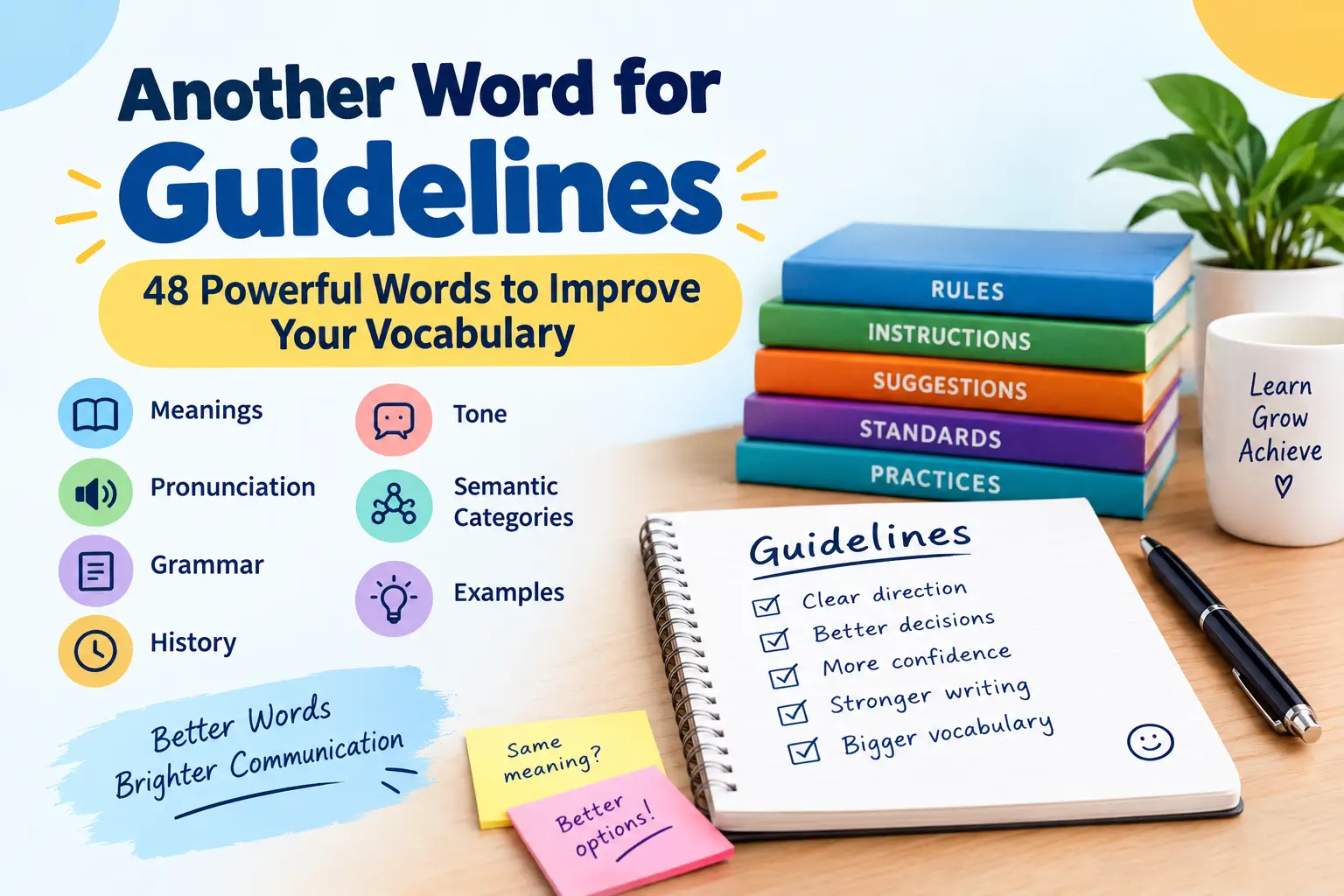
Another Word for Guidelines 48 Powerful Words to Improve Your Vocabulary
Guidelines are rules, instructions, or helpful suggestions that show people how to do something. For example, a teacher may give students guidelines for a class project. These guidelines explain what to do, how to do it, and what to avoid.
The word guidelines is common in schools, workplaces, businesses, health care, and daily life. However, using the same word again and again can make writing sound dull. Learning synonyms for guidelines helps English learners and content writers express ideas in a clear and natural way.
Some alternatives suggest strict rules, while others offer helpful advice or flexible directions. Choosing the right word depends on the situation and the meaning you want to share.
In this article, you will learn the meaning, pronunciation, history, and grammar of guidelines. You will also discover 48 synonyms, simple definitions, example sentences, antonyms, and useful word categories to improve your English.
Meaning of Guidelines
Definition
Guidelines (noun, plural): Rules, instructions, or suggestions that help people understand how to do something correctly or reach a goal.
Guidelines often explain the best way to complete a task. They may be strict or flexible, depending on the situation.
Examples
- The teacher gave us guidelines for writing the essay.
- Please follow the safety guidelines when using the machine.
Connotative Meaning
(Connotation is the feeling or idea that a word suggests beyond its basic meaning.)
- Positive tone: Guidelines can suggest support, clarity, helpful advice, and direction.
- Negative tone: In some situations, guidelines may suggest limits, pressure, or too much control.
- Neutral tone: Guidelines can simply describe instructions or standards that explain how something should be done.
The emotional tone depends on the context. Workplace guidelines may help employees, while overly strict guidelines may make people feel restricted.
Etymology of Guidelines
Origin of the Word
- Source language: The word combines the English words guide and line.
- Guide: Comes through Old French guider, meaning to lead or direct, with roots traced to Germanic languages.
- Line: Comes from Latin linea, meaning a linen thread or cord.
- Guideline: Developed in English to describe a line or principle that helps direct an action or decision.
Short History
- Old English (450–1100): The modern word guideline did not yet exist. Older English words related to leading, showing the way, and drawing lines expressed similar ideas.
- Middle English (1100–1500): English adopted and developed words related to guiding and directing through contact with French and other languages. These words helped express the idea of showing someone the way.
- Modern English (1500–present): The word guideline developed as a term for a guiding principle or instruction. Its plural form, guidelines, became widely useful in education, business, government, medicine, and technology.
Pronunciation
US and UK Pronunciation
- US IPA: /ˈɡaɪdˌlaɪnz/
- UK IPA: /ˈɡaɪd.laɪnz/
Syllables
guide-lines — 2 syllables.
The main stress falls on the first syllable.
Affixation Pattern of Guidelines
Root
- Guide: The base word refers to showing someone the way or helping them make a decision.
- Line: A word that can refer to a mark, path, or course of direction.
Prefix
– Prefix: None. The word guidelines does not contain a standard prefix.
Suffix
– -s: Added to guideline to form the regular plural guidelines.
Word Formation
- Guide (verb): To lead or direct someone.
- Guide (noun): A person or resource that provides help.
- Guidance (noun): Advice or help that directs an action.
- Guided (adjective or past-tense verb): Directed or helped by someone.
- Guiding (adjective or verb form): Providing direction or help.
- Guideline (noun): A principle or instruction that helps direct an action.
- Guidelines (plural noun): More than one guiding principle or instruction.
48 Synonyms of Guidelines
The best synonym depends on whether you mean formal rules, helpful advice, a step-by-step process, or a general standard. The following alternatives include their parts of speech, US and UK pronunciations, meanings, and examples.
1. Instructions (Noun)
US IPA: /ɪnˈstrʌkʃənz/ | UK IPA: /ɪnˈstrʌkʃənz/
Meaning: Information that explains how to do something.
Examples:
- Read the instructions before using the device.
- The teacher gave us clear instructions for the task.
2. Rules (Noun)
US IPA: /ruːlz/ | UK IPA: /ruːlz/
Meaning: Statements that explain what people must or must not do.
Examples:
- All players must follow the rules.
- The school has rules about mobile phone use.
3. Directions (Noun)
US IPA: /dəˈrɛkʃənz/ | UK IPA: /daɪˈrɛkʃənz/
Meaning: Information that tells someone how to proceed or reach a place.
Examples:
- Follow the directions on the package.
- She gave me directions to the library.
4. Recommendations (Noun)
US IPA: /ˌrɛkəmɛnˈdeɪʃənz/ | UK IPA: /ˌrɛkəmenˈdeɪʃənz/
Meaning: Suggestions about what someone should do.
Examples:
- The doctor shared recommendations for better sleep.
- We reviewed the team’s recommendations before deciding.
5. Advice (Noun)
US IPA: /ədˈvaɪs/ | UK IPA: /ədˈvaɪs/
Meaning: Helpful ideas that guide someone’s actions or decisions.
Examples:
- My teacher gave me advice about writing.
- Her advice helped us solve the problem.
6. Standards (Noun)
US IPA: /ˈstændərdz/ | UK IPA: /ˈstændədz/
Meaning: Accepted levels of quality or behavior that people are expected to meet.
Examples:
- The company follows high safety standards.
- Our work must meet the required standards.
7. Policies (Noun)
US IPA: /ˈpɑːləsiz/ | UK IPA: /ˈpɒləsiz/
Meaning: Official plans or principles that guide decisions and actions.
Examples:
- Please read the company’s privacy policies.
- The school updated its attendance policies.
8. Procedures (Noun)
US IPA: /prəˈsiːdʒərz/ | UK IPA: /prəˈsiːdʒəz/
Meaning: Established ways of completing a task or handling a situation.
Examples:
- Staff must follow emergency procedures.
- The office explained its hiring procedures.
9. Protocols (Noun)
US IPA: /ˈproʊtəkɔːlz/ | UK IPA: /ˈprəʊtəkɒlz/
Meaning: Formal rules or steps for handling a specific activity or situation.
Examples:
- Nurses follow patient safety protocols.
- The team agreed on communication protocols.
10. Criteria (Noun, plural)
US IPA: /kraɪˈtɪriə/ | UK IPA: /kraɪˈtɪəriə/
Meaning: Standards used to judge or evaluate something.
Examples:
- The judges explained the selection criteria.
- Applicants must meet the required criteria.
11. Principles (Noun)
US IPA: /ˈprɪnsəpəlz/ | UK IPA: /ˈprɪnsəpəlz/
Meaning: Basic beliefs or ideas that guide decisions and behavior.
Examples:
- Honesty is one of our main principles.
- The project follows simple design principles.
12. Recommendations for Practice (Noun Phrase)
US IPA: /ˌrɛkəmɛnˈdeɪʃənz fər ˈpræktɪs/ | UK IPA: /ˌrɛkəmenˈdeɪʃənz fə ˈpræktɪs/
Meaning: Suggestions about the best way to carry out a particular activity.
Examples:
- The report includes recommendations for practice.
- Teachers discussed recommendations for classroom practice.
13. Advice Notes (Noun Phrase)
US IPA: /ədˈvaɪs noʊts/ | UK IPA: /ədˈvaɪs nəʊts/
Meaning: Written notes that provide helpful suggestions or guidance.
Examples:
- The manager shared advice notes with the team.
- I saved the advice notes for future reference.
14. Specifications (Noun)
US IPA: /ˌspɛsəfəˈkeɪʃənz/ | UK IPA: /ˌspesɪfɪˈkeɪʃənz/
Meaning: Detailed statements of the requirements or features something must meet.
Examples:
- The product must meet the listed specifications.
- The designer checked the project specifications.
15. Requirements (Noun)
US IPA: /rɪˈkwaɪərmənts/ | UK IPA: /rɪˈkwaɪəmənts/
Meaning: Conditions or things that must be met or completed.
Examples:
- Read the job requirements before applying.
- The project has several important requirements.
16. Regulations (Noun)
US IPA: /ˌrɛɡjəˈleɪʃənz/ | UK IPA: /ˌreɡjʊˈleɪʃənz/
Meaning: Official rules made by an authority to control an activity.
Examples:
- The business must follow local regulations.
- New regulations affect how the company operates.
17. Directives (Noun)
US IPA: /dəˈrɛktɪvz/ | UK IPA: /daɪˈrektɪvz/
Meaning: Official instructions that tell people what action to take.
Examples:
- The director issued new directives.
- Employees followed the safety directives.
18. Mandates (Noun)
US IPA: /ˈmænˌdeɪts/ | UK IPA: /ˈmændeɪts/
Meaning: Official orders or requirements that give authority or make an action necessary.
Examples:
- The new mandates apply to all departments.
- The agency introduced several workplace mandates.
19. Orders (Noun)
US IPA: /ˈɔːrdərz/ | UK IPA: /ˈɔːdəz/
Meaning: Commands that tell someone what must be done.
Examples:
- The officer gave clear orders.
- The workers followed the manager’s orders.
20. Commandments (Noun)
US IPA: /kəˈmændmənts/ | UK IPA: /kəˈmɑːndmənts/
Meaning: Important rules or commands, often linked to religion or moral behavior.
Examples:
- The class studied the Ten Commandments.
- The coach jokingly shared his commandments for success.
21. Frameworks (Noun)
US IPA: /ˈfreɪmˌwɜːrks/ | UK IPA: /ˈfreɪmˌwɜːks/
Meaning: Structures or systems that help organize ideas and actions.
Examples:
- The team created a framework for planning.
- This framework helps us make better decisions.
22. Principles of Practice (Noun Phrase)
US IPA: /ˈprɪnsəpəlz əv ˈpræktɪs/ | UK IPA: /ˈprɪnsəpəlz əv ˈpræktɪs/
Meaning: Basic ideas that guide how a task or profession is carried out.
Examples:
- The course teaches principles of practice.
- Staff reviewed the principles of practice together.
23. Handbooks (Noun)
US IPA: /ˈhændˌbʊks/ | UK IPA: /ˈhændˌbʊks/
Meaning: Books that provide useful information, instructions, or rules about a subject.
Examples:
- New employees receive staff handbooks.
- I checked the handbook for travel rules.
24. Manuals (Noun)
US IPA: /ˈmænjuəlz/ | UK IPA: /ˈmænjʊəlz/
Meaning: Documents or books that explain how to use, operate, or do something.
Examples:
- The user manual explains how to install the software.
- Workers read the safety manual before training.
25. Playbooks (Noun)
US IPA: /ˈpleɪˌbʊks/ | UK IPA: /ˈpleɪˌbʊks/
Meaning: Collections of strategies and instructions for handling common situations.
Examples:
- The marketing team created a campaign playbook.
- Our playbook explains how to handle customer complaints.
26. Checklists (Noun)
US IPA: /ˈtʃɛkˌlɪsts/ | UK IPA: /ˈtʃekˌlɪsts/
Meaning: Lists of tasks or points to check before finishing something.
Examples:
- Use the checklist before publishing the article.
- The pilot reviewed the safety checklist.
27. Guidelines for Conduct (Noun Phrase)
US IPA: /ˈɡaɪdˌlaɪnz fər ˈkɑːndʌkt/ | UK IPA: /ˈɡaɪdˌlaɪnz fə ˈkɒndʌkt/
Meaning: Rules or principles that explain how people should behave.
Examples:
- The school published guidelines for conduct.
- Employees must understand the guidelines for conduct.
28. Best Practices (Noun Phrase)
US IPA: /ˌbɛst ˈpræktɪsɪz/ | UK IPA: /ˌbest ˈpræktɪsɪz/
Meaning: Methods widely regarded as effective ways to complete a task.
Examples:
- The guide explains best practices for SEO.
- We follow best practices when protecting user data.
29. Ground Rules (Noun Phrase)
US IPA: /ˈɡraʊnd ˌruːlz/ | UK IPA: /ˈɡraʊnd ˌruːlz/
Meaning: Basic rules agreed upon before an activity begins.
Examples:
- The group set ground rules for discussion.
- We agreed on ground rules before starting the project.
30. Norms (Noun)
US IPA: /nɔːrmz/ | UK IPA: /nɔːmz/
Meaning: Commonly accepted ways of behaving within a group or society.
Examples:
- The team discussed workplace norms.
- Social norms can differ across cultures.
31. Expectations (Noun)
US IPA: /ˌɛkspɛkˈteɪʃənz/ | UK IPA: /ˌekspekˈteɪʃənz/
Meaning: Ideas about what people should do or what results they should achieve.
Examples:
- The manager explained her expectations.
- Clear expectations help students understand their work.
32. Benchmarks (Noun)
US IPA: /ˈbɛntʃˌmɑːrks/ | UK IPA: /ˈbentʃˌmɑːks/
Meaning: Points of reference used to measure progress or performance.
Examples:
- The team set benchmarks for monthly growth.
- We compared our results with industry benchmarks.
33. Parameters (Noun)
US IPA: /pəˈræmətərz/ | UK IPA: /pəˈræmɪtəz/
Meaning: Limits or conditions that define how something can be done.
Examples:
- The project must stay within the agreed parameters.
- The designer explained the search parameters.
34. Guidelines for Use (Noun Phrase)
US IPA: /ˈɡaɪdˌlaɪnz fər ˈjuːs/ | UK IPA: /ˈɡaɪdˌlaɪnz fə ˈjuːs/
Meaning: Instructions that explain how something should be used.
Examples:
- The website includes guidelines for use.
- Please review the guidelines for use before installing the tool.
35. Instructions for Use (Noun Phrase)
US IPA: /ɪnˈstrʌkʃənz fər ˈjuːs/ | UK IPA: /ɪnˈstrʌkʃənz fə ˈjuːs/
Meaning: Directions that explain the proper way to use a product or service.
Examples:
- Read the instructions for use carefully.
- The package contains instructions for use.
36. Operating Procedures (Noun Phrase)
US IPA: /ˈɑːpəˌreɪtɪŋ prəˈsiːdʒərz/ | UK IPA: /ˈɒpəreɪtɪŋ prəˈsiːdʒəz/
Meaning: Established steps for running a machine, system, or workplace activity.
Examples:
- The staff reviewed the operating procedures.
- Follow the operating procedures when starting the machine.
37. Codes of Conduct (Noun Phrase)
US IPA: /ˌkoʊdz əv ˈkɑːndʌkt/ | UK IPA: /ˌkəʊdz əv ˈkɒndʌkt/
Meaning: Written standards that describe acceptable behavior.
Examples:
- All members must follow the code of conduct.
- The organization updated its codes of conduct.
38. Policies and Procedures (Noun Phrase)
US IPA: /ˈpɑːləsiz ænd prəˈsiːdʒərz/ | UK IPA: /ˈpɒləsiz ænd prəˈsiːdʒəz/
Meaning: Official rules and established steps for managing work or activities.
Examples:
- New staff must learn the policies and procedures.
- The handbook explains the company’s policies and procedures.
39. Normative Standards (Noun Phrase)
US IPA: /ˈnɔːrmətɪv ˈstændərdz/ | UK IPA: /ˈnɔːmətɪv ˈstændədz/
Meaning: Standards that describe how people or things are expected to be.
Examples:
- The report examines normative standards in the profession.
- Normative standards shape expected workplace behavior.
40. Specifications for Work (Noun Phrase)
US IPA: /ˌspɛsəfəˈkeɪʃənz fər ˈwɜːrk/ | UK IPA: /ˌspesɪfɪˈkeɪʃənz fə ˈwɜːk/
Meaning: Details that define the requirements for completing a particular job or task.
Examples:
- The contractor checked the specifications for work.
- We reviewed the specifications for work before construction began.
41. Direct Guidance (Noun Phrase)
US IPA: /dəˈrɛkt ˈɡaɪdəns/ | UK IPA: /daɪˈrekt ˈɡaɪdəns/
Meaning: Clear help that tells someone how to proceed.
Examples:
- The new employee needed direct guidance.
- Her direct guidance helped us finish the task.
42. Advice and Guidance (Noun Phrase)
US IPA: /ədˈvaɪs ænd ˈɡaɪdəns/ | UK IPA: /ədˈvaɪs ænd ˈɡaɪdəns/
Meaning: Suggestions and support that help someone make decisions or take action.
Examples:
- Students can ask their teachers for advice and guidance.
- The consultant provided advice and guidance on the project.
43. Recommendations and Standards (Noun Phrase)
US IPA: /ˌrɛkəmɛnˈdeɪʃənz ænd ˈstændərdz/ | UK IPA: /ˌrekəmenˈdeɪʃənz ænd ˈstændədz/
Meaning: Suggested actions together with accepted levels of quality or performance.
Examples:
- The report lists recommendations and standards for the industry.
- We reviewed the recommendations and standards before making changes.
44. Reference Points (Noun Phrase)
US IPA: /ˈrɛfərəns ˌpɔɪnts/ | UK IPA: /ˈrefərəns ˌpɔɪnts/
Meaning: Facts, examples, or standards used to compare or judge something.
Examples:
- The team used past results as reference points.
- These reference points helped us measure progress.
45. Templates (Noun)
US IPA: /ˈtɛmˌpleɪts/ | UK IPA: /ˈtemˌpleɪts/
Meaning: Pre-made formats that help people create something in a consistent way.
Examples:
- The company provides templates for reports.
- I used a template to organize the document.
46. Roadmaps (Noun)
US IPA: /ˈroʊdˌmæps/ | UK IPA: /ˈrəʊdˌmæps/
Meaning: Plans that show the main steps toward a goal.
Examples:
- The team created a roadmap for the new website.
- Her learning roadmap includes weekly writing practice.
47. Strategies (Noun)
US IPA: /ˈstrætədʒiz/ | UK IPA: /ˈstrætədʒiz/
Meaning: Plans designed to achieve a particular goal.
Examples:
- The business developed strategies for growth.
- We discussed strategies for improving reading skills.
48. Guidelines for Decision-Making (Noun Phrase)
US IPA: /ˈɡaɪdˌlaɪnz fər dɪˈsɪʒən ˌmeɪkɪŋ/ | UK IPA: /ˈɡaɪdˌlaɪnz fə dɪˈsɪʒən ˌmeɪkɪŋ/
Meaning: Principles or instructions that help people make choices.
Examples:
- The board adopted guidelines for decision-making.
- Clear guidelines for decision-making help the team compare options.
Prototype Meaning of Guidelines
The most typical meaning of guidelines is a set of instructions or principles that helps people complete a task correctly. When people hear this word, they often imagine a written document that explains what to do, what to avoid, and how to meet certain expectations. For example, a school may publish guidelines for students, while a company may provide guidelines for employees. Guidelines usually offer direction without explaining every small step. However, some guidelines may be mandatory when they are linked to official policies or regulations.
Prototype Categorization
Synonyms for guidelines can be grouped by their main purpose. These categories help writers select a word that fits the meaning, tone, and situation.
- Rules and requirements: Rules, regulations, mandates, orders, and requirements. Use these words when something must be followed or completed.
- Advice and suggestions: Advice, recommendations, direct guidance, and advice and guidance. These terms suit situations where people receive help rather than strict commands.
- Steps and processes: Instructions, directions, procedures, protocols, and operating procedures. Use these words to explain how to complete a task.
- Quality and performance: Standards, benchmarks, criteria, specifications, and normative standards. These words work well when discussing quality, evaluation, or expected results.
- Values and behavior: Principles, norms, ground rules, and codes of conduct. These terms are useful for describing expected behavior or shared beliefs.
- Plans and organization: Frameworks, roadmaps, strategies, playbooks, and templates. Use these words when discussing ways to organize work or reach a goal.
- Reference and support materials: Handbooks, manuals, checklists, and reference points. These words describe resources that help people follow a process or check their work.
Categorization prevents writers from choosing words that do not fit their message. For example, recommendations sounds less forceful than regulations, while procedures focuses more on steps than on general principles.
Antonyms of Guidelines
Antonyms are words with opposite or contrasting meanings. Since guidelines provide direction, their opposites often suggest a lack of direction, structure, or rules.
- Disorder (noun): A state without proper order or organization.
- Chaos (noun): A state of complete confusion or disorder.
- Freedom (noun): The ability to act or choose without certain restrictions.
- Improvisation (noun): The act of doing something without a prepared plan.
- Spontaneity (noun): The quality of acting naturally without careful planning.
- Uncertainty (noun): A state of not knowing what to do or what will happen.
- Confusion (noun): A lack of clear understanding.
- Disorganization (noun): A lack of order or proper planning.
- Arbitrariness (noun): The quality of making choices without a clear rule or reason.
- Noncompliance (noun): Failure to follow a rule, instruction, or requirement.
These words are not exact opposites in every context. For example, freedom may contrast with strict guidelines, but it does not always mean that guidelines are absent.
Short Questions and Answers
What do guidelines mean?
Guidelines are instructions, rules, or suggestions that help people understand how to complete a task or make a decision.
When should guidelines be used?
Use guidelines when explaining expected behavior, offering direction, setting expectations, or helping people follow a process.
Are guidelines positive or negative?
Guidelines are generally neutral. They can be helpful when they provide clear direction, but overly restrictive guidelines may feel limiting.
How are guidelines different from similar words?
Guidelines usually offer general direction. Rules state what is allowed or required, instructions explain what to do, procedures describe established steps, and recommendations suggest what may work best.
Conclusion
Learning the meaning of guidelines and its synonyms can improve your English vocabulary and make your writing clearer. Words such as instructions, recommendations, standards, procedures, and principles help you express different kinds of direction without repeating the same word.
Choosing the right synonym also helps you match your tone to your audience. For example, use rules for requirements, advice for helpful suggestions, and procedures for specific steps. Understanding pronunciation, word history, grammar, and meaning can also strengthen your speaking and writing skills.
To build confidence, practice learning a few new words each day. Write your own sentences, read examples, and notice how different words are used in real situations. With regular practice, you can express your ideas more naturally and communicate with greater confidence.

Emily Morgan is an English language and vocabulary writer who helps readers find clear, natural, and useful alternatives to everyday words. She focuses on synonyms, word choice, tone, and practical English usage, making vocabulary easier to understand and apply in real conversations and writing.