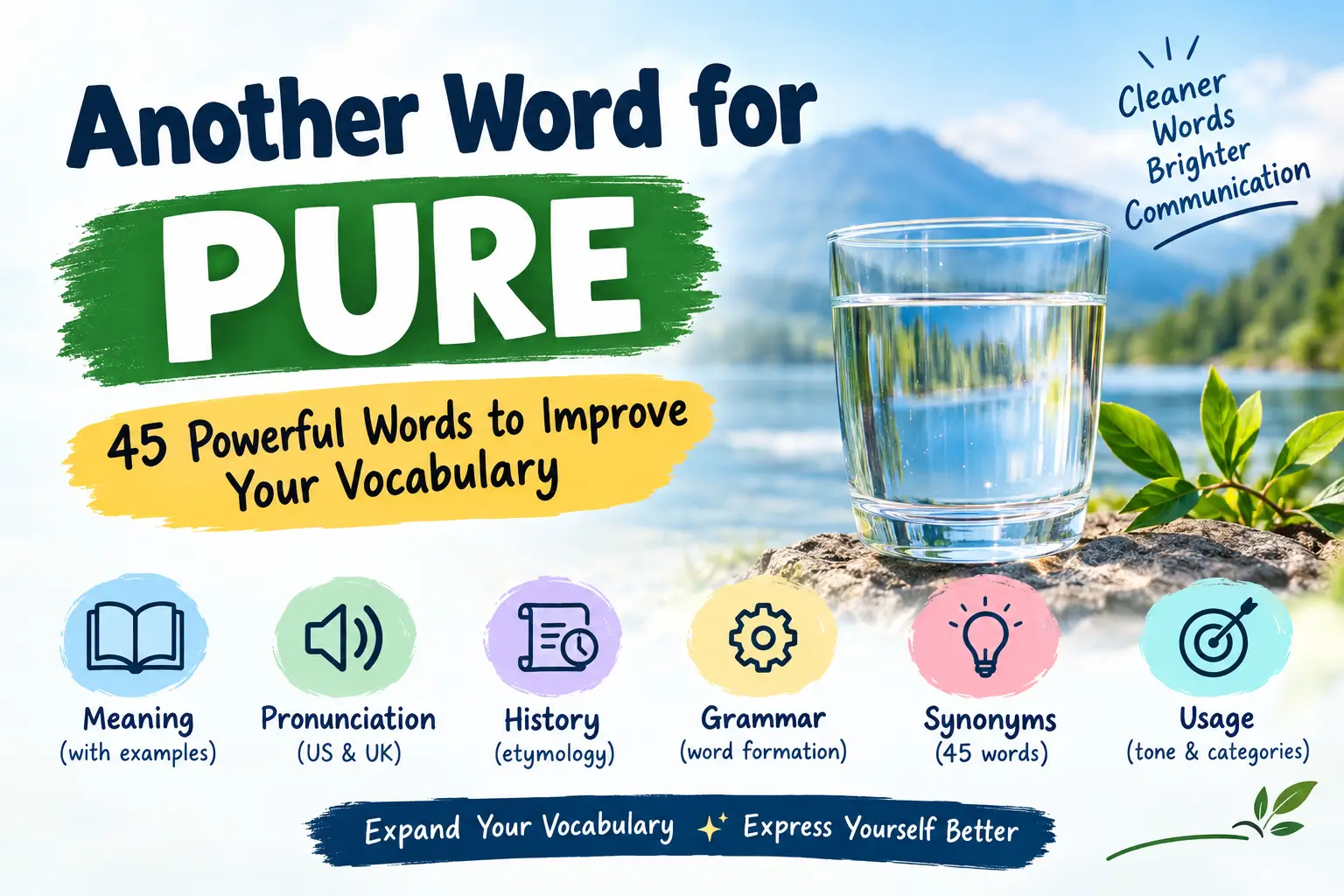
Another Word for Pure 45 Powerful Words to Improve Your Vocabulary
Pure means free from anything unwanted, mixed, or harmful. Imagine drinking a glass of water that is clear, clean, and safe. You might call it pure water because nothing has been added to it.
The word is also used for ideas, feelings, motives, colors, sounds, and materials. For example, someone may have pure intentions when they truly want to help without expecting anything in return.
The word pure is common because it can describe both physical and abstract things. Learning synonyms for pure helps English learners choose words that fit different situations.
It also helps content writers avoid repeating the same word. In this guide, you will learn the meaning, synonyms, examples, grammar, pronunciation, history, word formation, connotations, and semantic categories of pure. These details will help you understand when each synonym sounds natural.
Meaning of Pure
Definition
Pure (adjective):
Free from unwanted substances, mixtures, pollution, or anything that changes its original quality.
Pure can also describe something that is morally good, sincere, simple, or complete.
Examples
- The scientist tested the pure water in the laboratory.
- Her pure kindness made everyone feel welcome.
Connotative Meaning
Connotation (the feeling or idea that a word suggests beyond its basic dictionary meaning):
- Positive tone: Pure often suggests cleanliness, goodness, honesty, innocence, or sincerity.
- Negative tone: In some contexts, pure can sound strict or extreme, especially when used to suggest that something must remain completely free from outside influence.
- Neutral tone: Pure can simply describe a substance that contains only one main material, such as pure gold.
Etymology
- Source: Middle English pur, from Old French pur.
- Earlier source: Latin purus, meaning “clean,” “clear,” or “unmixed.”
- The basic idea has remained connected to cleanliness and freedom from unwanted material.
Short History of Pure
- Old English (450–1100): The modern form pure was not yet the normal English word. English used native terms related to cleanliness and purity.
- Middle English (1100–1500): Forms related to Old French pur entered English after the Norman French influence. The word began to develop its modern uses.
- Modern English (1500–Present): Pure became widely used for physical substances, moral qualities, intentions, emotions, sounds, colors, and abstract ideas.
Pronunciation (US & UK – IPA)
US: /pjʊr/
UK: /pjʊə/
Syllables
pure
Affixation Pattern of Pure
- Root: pur-
- Prefix: none
- Suffix: none
- Word formation: The base word pure is an adjective. Related forms include:
- purity — noun
- purely — adverb
- purify — verb
- purified — adjective/past participle
- purification — noun
- purifier — noun
- impure — adjective
- impurity — noun
Synonyms of Pure
1. Clean (Adjective)
US IPA: /kliːn/ | UK IPA: /kliːn/
Meaning: Free from dirt, pollution, or unwanted material.
Examples:
- The mountain provides clean water.
- Make sure the container is clean before using it.
2. Uncontaminated (Adjective)
US IPA: /ˌʌnkənˈtæməneɪtɪd/ | UK IPA: /ˌʌnkənˈtæmɪneɪtɪd/
Meaning: Not affected by harmful or unwanted substances.
Examples:
- The sample was completely uncontaminated.
- Researchers searched for uncontaminated soil.
3. Unmixed (Adjective)
US IPA: /ʌnˈmɪkst/ | UK IPA: /ʌnˈmɪkst/
Meaning: Not combined with another substance.
Examples:
- The bottle contains unmixed oil.
- The chef used unmixed ingredients for the test.
4. Unadulterated (Adjective)
US IPA: /ˌʌnəˈdʌltəreɪtɪd/ | UK IPA: /ˌʌnəˈdʌltəreɪtɪd/
Meaning: Not changed or weakened by adding another substance.
Examples:
- The product contains unadulterated honey.
- They wanted unadulterated natural flavor.
5. Unpolluted (Adjective)
US IPA: /ˌʌnpəˈluːtɪd/ | UK IPA: /ˌʌnpəˈluːtɪd/
Meaning: Free from pollution.
Examples:
- The lake has unpolluted water.
- They searched for an unpolluted area.
6. Pristine (Adjective)
US IPA: /ˈprɪstiːn/ | UK IPA: /ˈprɪstiːn/
Meaning: Extremely clean and in its original condition.
Examples:
- We found a pristine beach.
- The forest remained pristine for many years.
7. Spotless (Adjective)
US IPA: /ˈspɑːtləs/ | UK IPA: /ˈspɒtləs/
Meaning: Completely clean with no marks or dirt.
Examples:
- Her kitchen was spotless.
- The hotel room was spotless when we arrived.
8. Immaculate (Adjective)
US IPA: /ɪˈmækjələt/ | UK IPA: /ɪˈmækjələt/
Meaning: Perfectly clean or free from faults.
Examples:
- His white shirt was immaculate.
- The garden looked immaculate.
9. Unblemished (Adjective)
US IPA: /ʌnˈblɛmɪʃt/ | UK IPA: /ʌnˈblɛmɪʃt/
Meaning: Having no marks, damage, or flaws.
Examples:
- The stone had an unblemished surface.
- She had an unblemished record.
10. Unsullied (Adjective)
US IPA: /ʌnˈsʌlid/ | UK IPA: /ʌnˈsʌlɪd/
Meaning: Not spoiled, damaged, or morally stained.
Examples:
- The village had an unsullied natural beauty.
- He wanted to keep his reputation unsullied.
11. Untainted (Adjective)
US IPA: /ʌnˈteɪntɪd/ | UK IPA: /ʌnˈteɪntɪd/
Meaning: Not affected by something harmful or negative.
Examples:
- She wanted an untainted environment.
- His childhood memories remained untainted.
12. Uncorrupted (Adjective)
US IPA: /ˌʌnkəˈrʌptɪd/ | UK IPA: /ˌʌnkəˈrʌptɪd/
Meaning: Not damaged morally or changed for the worse.
Examples:
- The story presents an uncorrupted view of childhood.
- He hoped to remain uncorrupted by greed.
13. Innocent (Adjective)
US IPA: /ˈɪnəsənt/ | UK IPA: /ˈɪnəsənt/
Meaning: Free from guilt, evil, or harmful intentions.
Examples:
- She gave him an innocent smile.
- His question was completely innocent.
14. Virtuous (Adjective)
US IPA: /ˈvɝːtʃuəs/ | UK IPA: /ˈvɜːtʃuəs/
Meaning: Showing strong moral goodness.
Examples:
- She was known for her virtuous behavior.
- The story describes a virtuous leader.
15. Moral (Adjective)
US IPA: /ˈmɔːrəl/ | UK IPA: /ˈmɒrəl/
Meaning: Connected with good behavior and accepted principles.
Examples:
- He had a strong moral purpose.
- Her decision was based on moral values.
16. Righteous (Adjective)
US IPA: /ˈraɪtʃəs/ | UK IPA: /ˈraɪtʃəs/
Meaning: Morally good or behaving according to strong moral beliefs.
Examples:
- He believed he was fighting for a righteous cause.
- The novel describes a righteous character.
17. Upright (Adjective)
US IPA: /ˈʌpraɪt/ | UK IPA: /ˈʌpraɪt/
Meaning: Honest and morally good.
Examples:
- She is an upright and honest person.
- Everyone trusted his upright character.
18. Honest (Adjective)
US IPA: /ˈɑːnɪst/ | UK IPA: /ˈɒnɪst/
Meaning: Truthful and sincere.
Examples:
- He gave an honest answer.
- Her honest intentions were clear.
19. Sincere (Adjective)
US IPA: /sɪnˈsɪr/ | UK IPA: /sɪnˈsɪə/
Meaning: Genuine and not pretending.
Examples:
- She gave him a sincere apology.
- His thanks were sincere.
20. Genuine (Adjective)
US IPA: /ˈdʒɛnjuɪn/ | UK IPA: /ˈdʒɛnjuɪn/
Meaning: Real, true, and not fake.
Examples:
- She showed genuine concern.
- His smile was genuine.
21. Authentic (Adjective)
US IPA: /ɔːˈθɛntɪk/ | UK IPA: /ɔːˈθɛntɪk/
Meaning: Real and true to its original form.
Examples:
- The museum displays an authentic artifact.
- They wanted an authentic local experience.
22. Natural (Adjective)
US IPA: /ˈnætʃərəl/ | UK IPA: /ˈnætʃrəl/
Meaning: Existing or occurring without artificial change.
Examples:
- The product contains natural ingredients.
- She has a natural ability to teach.
23. Unprocessed (Adjective)
US IPA: /ˌʌnˈprɑːsest/ | UK IPA: /ˌʌnˈprəʊsest/
Meaning: Not changed by industrial or mechanical processing.
Examples:
- The recipe uses unprocessed foods.
- They prefer unprocessed grains.
24. Refined (Adjective)
US IPA: /rɪˈfaɪnd/ | UK IPA: /rɪˈfaɪnd/
Meaning: Made cleaner or more concentrated by removing unwanted parts.
Examples:
- The factory produces refined sugar.
- Refined oil is used in many products.
25. Concentrated (Adjective)
US IPA: /ˈkɑːnsəntreɪtɪd/ | UK IPA: /ˈkɒnsəntreɪtɪd/
Meaning: Containing a high amount of a particular substance.
Examples:
- The juice is highly concentrated.
- Use a small amount of the concentrated solution.
26. Clear (Adjective)
US IPA: /klɪr/ | UK IPA: /klɪə/
Meaning: Easy to see through or free from cloudiness.
Examples:
- The stream has clear water.
- We could see the bottom through the clear lake.
27. Transparent (Adjective)
US IPA: /trænsˈpærənt/ | UK IPA: /trænsˈpærənt/
Meaning: Allowing light to pass through so objects can be seen.
Examples:
- The bottle is made of transparent glass.
- The liquid became transparent after filtering.
28. Untouched (Adjective)
US IPA: /ʌnˈtʌtʃt/ | UK IPA: /ʌnˈtʌtʃt/
Meaning: Not changed, used, or affected.
Examples:
- The snow looked untouched.
- The natural area remained untouched.
29. Unspoiled (Adjective)
US IPA: /ʌnˈspɔɪld/ | UK IPA: /ʌnˈspɔɪld/
Meaning: Not damaged or changed from its natural state.
Examples:
- They visited an unspoiled island.
- The valley is still unspoiled by development.
30. Virgin (Adjective)
US IPA: /ˈvɝːdʒɪn/ | UK IPA: /ˈvɜːdʒɪn/
Meaning: Not previously used, processed, or developed.
Examples:
- The company uses virgin materials in the process.
- The scientists studied virgin soil.
31. Untouched (Adjective)
US IPA: /ʌnˈtʌtʃt/ | UK IPA: /ʌnˈtʌtʃt/
Meaning: Left in its original condition.
Examples:
- The ancient site remained untouched.
- The package was still untouched.
32. Unspoiled (Adjective)
US IPA: /ʌnˈspɔɪld/ | UK IPA: /ʌnˈspɔɪld/
Meaning: Preserved without damage or unwanted change.
Examples:
- The coast has an unspoiled beauty.
- Visitors admired the unspoiled landscape.
33. Unmixed (Adjective)
US IPA: /ʌnˈmɪkst/ | UK IPA: /ʌnˈmɪkst/
Meaning: Kept separate from other substances.
Examples:
- The laboratory stored the chemicals unmixed.
- The ingredients should remain unmixed until later.
34. Unalloyed (Adjective)
US IPA: /ˌʌnəˈlɔɪd/ | UK IPA: /ˌʌnəˈlɔɪd/
Meaning: Complete and not mixed with anything else, especially in an abstract sense.
Examples:
- The news brought unalloyed joy.
- She felt unalloyed happiness at the result.
35. Absolute (Adjective)
US IPA: /ˈæbsəluːt/ | UK IPA: /ˈæbsəluːt/
Meaning: Complete and not limited or mixed with anything else.
Examples:
- The child spoke with absolute confidence.
- The decision brought absolute relief.
36. Sheer (Adjective)
US IPA: /ʃɪr/ | UK IPA: /ʃɪə/
Meaning: Complete or extreme in degree.
Examples:
- They succeeded through sheer determination.
- The view was sheer beauty.
37. Unqualified (Adjective)
US IPA: /ˌʌnˈkwɑːləfaɪd/ | UK IPA: /ˌʌnˈkwɒlɪfaɪd/
Meaning: Complete and not limited by conditions.
Examples:
- She gave her unqualified support.
- The proposal received unqualified approval.
38. Unconditional (Adjective)
US IPA: /ˌʌnkənˈdɪʃənəl/ | UK IPA: /ˌʌnkənˈdɪʃənəl/
Meaning: Given without requiring anything in return.
Examples:
- Children need unconditional love.
- He offered unconditional support.
39. Simple (Adjective)
US IPA: /ˈsɪmpəl/ | UK IPA: /ˈsɪmpəl/
Meaning: Free from unnecessary parts or complexity.
Examples:
- She enjoyed the simple beauty of the garden.
- His simple intentions were easy to understand.
40. Unaffected (Adjective)
US IPA: /ˌʌnəˈfæktɪd/ | UK IPA: /ˌʌnəˈfæktɪd/
Meaning: Natural and not changed by outside influence.
Examples:
- Her response seemed unaffected.
- The landscape remained unaffected by the storm.
41. Unbiased (Adjective)
US IPA: /ˌʌnˈbaɪəst/ | UK IPA: /ˌʌnˈbaɪəst/
Meaning: Not influenced by personal preferences or prejudice.
Examples:
- We need an unbiased opinion.
- The judge should remain unbiased.
42. Impartial (Adjective)
US IPA: /ɪmˈpɑːrʃəl/ | UK IPA: /ɪmˈpɑːʃəl/
Meaning: Fair and not favoring one side.
Examples:
- The judge remained impartial.
- An impartial review can help readers.
43. Chaste (Adjective)
US IPA: /tʃeɪst/ | UK IPA: /tʃeɪst/
Meaning: Morally or sexually modest according to traditional standards.
Examples:
- The character was portrayed as chaste.
- The poem uses chaste and restrained language.
44. Innocuous (Adjective)
US IPA: /ɪˈnɑːkjuəs/ | UK IPA: /ɪˈnɒkjuəs/
Meaning: Harmless and unlikely to cause trouble or harm.
Examples:
- He made an innocuous comment.
- The question seemed innocuous at first.
45. Unblemished (Adjective)
US IPA: /ʌnˈblɛmɪʃt/ | UK IPA: /ʌnˈblɛmɪʃt/
Meaning: Free from visible flaws or negative marks.
Examples:
- The diamond had an unblemished surface.
- She maintained an unblemished professional record.
Prototype Meaning
The most typical meaning of pure is something that is completely clean, unmixed, or free from unwanted material. When people hear pure, they often imagine clear water, clean air, pure gold, or a substance in its original form. The word can also describe an innocent heart, sincere intentions, or genuine feelings. Its exact meaning depends on the noun it describes.
Prototype Categorization
- Physical cleanliness: clean, spotless, immaculate, pristine, unpolluted
- Freedom from contamination: uncontaminated, untainted, unadulterated, unmixed
- Natural condition: natural, untouched, unspoiled, unaffected
- Moral goodness: virtuous, righteous, upright, moral
- Honesty and sincerity: sincere, genuine, authentic, honest
- Complete or unrestricted quality: absolute, sheer, unqualified, unconditional
- Scientific or material purity: refined, concentrated, unprocessed, clear
- Fairness and neutrality: unbiased, impartial
- Innocence: innocent, chaste
This categorization helps writers choose the right synonym instead of replacing pure with a word that has a slightly different meaning. For example, unpolluted works well for water or air, while sincere is better for feelings or intentions. Virtuous focuses on moral behavior, while unmixed focuses on physical substances.
Antonyms of Pure
Impure (Adjective)
Containing unwanted substances or lacking moral purity.
Contaminated (Adjective)
Containing harmful or unwanted material.
Polluted (Adjective)
Made dirty or harmful by pollution.
Mixed (Adjective)
Combined with another substance or element.
Tainted (Adjective)
Affected by something harmful, unpleasant, or negative.
Corrupt (Adjective)
Damaged morally or ethically.
Artificial (Adjective)
Made or produced by human processes rather than occurring naturally.
Fake (Adjective)
Not genuine or real.
Dishonest (Adjective)
Not truthful or sincere.
Guilty (Adjective)
Responsible for a wrongdoing or crime.
Short Questions and Answers
What does pure mean?
Pure means free from unwanted material, contamination, mixture, or negative influence.It can also mean sincere, innocent, genuine, or morally good.
When should pure be used?
Use pure when something is completely clean, unmixed, natural, sincere, or free from unwanted influence. For physical substances, it can describe materials such as water, gold, or chemicals. For abstract ideas, it can describe feelings, motives, intentions, or goodness.
Is pure positive or negative?
Pure usually has a positive connotation. It can suggest cleanliness, innocence, goodness, or sincerity. The meaning can change depending on context.
How is pure different from similar words?
Pure is broad and can describe both physical and abstract qualities.
Clean usually focuses on freedom from dirt or unwanted material.
Pristine suggests something extremely clean and untouched.
Sincere focuses on honest feelings or intentions.
Genuine means real rather than fake.
Uncontaminated is especially useful for substances that have not been polluted.
Virtuous focuses on moral goodness.
Conclusion
Learning the word pure and its synonyms can make your English clearer and more flexible. Instead of using pure in every situation, you can choose words such as clean, pristine, sincere, genuine, uncontaminated, or virtuous based on the exact meaning you want.
This improves both writing and speaking because each word carries its own shade of meaning. A wider vocabulary also helps you avoid repetition and express ideas with greater accuracy.
Understanding pronunciation, connotation, history, grammar, and semantic categories gives you a stronger command of the word. For the best results, practice one or two new synonyms each day. Write simple sentences, read them aloud, and notice how native speakers use these words in real situations.
Emily Morgan is an English language and vocabulary writer who helps readers find clear, natural, and useful alternatives to everyday words. She focuses on synonyms, word choice, tone, and practical English usage, making vocabulary easier to understand and apply in real conversations and writing.