
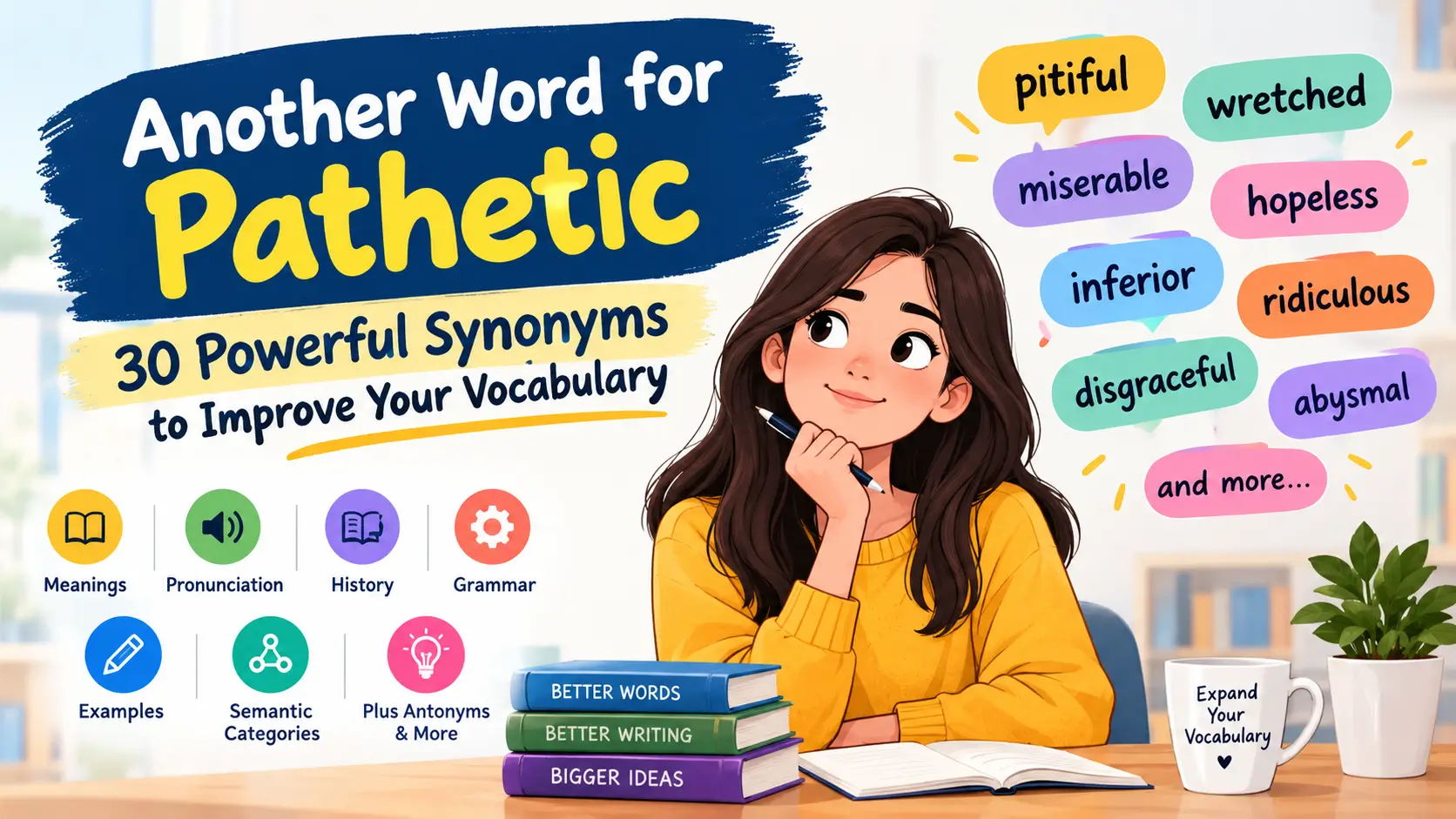
Another Word for Pathetic 30 Powerful Words to Improve Your Vocabulary
The word pathetic describes something that makes people feel pity, disappointment, or even contempt. For example, imagine a team that loses a game because no one tries their best. Someone might call the team’s effort pathetic. The word is common in daily conversations, books, movies, and online discussions.
However, pathetic can sound harsh or insulting when used to describe a person. Learning synonyms helps you express your thoughts in a clearer and more suitable way. English learners can use these words to build vocabulary, while writers can avoid repeating the same word.
In this guide, you will learn the meaning of pathetic, its pronunciation, history, grammar, and 30 useful synonyms. You will also discover examples, word categories, and antonyms to help you choose the right word for each situation.
Meaning of Pathetic
Definition
Pathetic (adjective): Causing pity, showing weakness, or being so poor or unsuccessful that it deserves criticism or disappointment.
The word can describe a weak effort, a sad situation, or something of very low quality. Its exact meaning depends on the context.
Examples
- His pathetic excuse did not convince the teacher.
- The abandoned puppy looked pathetic in the cold rain.
- Their team made a pathetic attempt to win the match.
Connotative Meaning
- Positive tone: Pathetic rarely has a positive tone. In some situations, it may inspire pity or sympathy for someone who is suffering.
- Negative tone: It often suggests weakness, failure, poor quality, or something deserving ridicule.
- Neutral tone: It can describe a situation that causes sadness or pity without directly insulting anyone, although the word often carries a strong emotional tone.
Etymology of Pathetic
Origin of the Word
- Source language: Greek, through Latin and French.
- Greek root: Pathētikos, related to feeling or emotion.
- Original meaning: Able to stir feelings or emotions.
- Modern meaning: Causing pity or expressing something weak, poor, or disappointing.
Short History of the Keyword
- Old English (450–1100): The modern English word pathetic was not commonly used in Old English. Related ideas were expressed through words connected with suffering, sorrow, and pity.
- Middle English (1100–1500): English borrowed many French and Latin words during this period. The linguistic roots that later gave rise to pathetic were linked to emotion and suffering.
- Modern English (1500–Present): Pathetic entered English through French and Latin influences. It first had strong links to emotion and the ability to move people. Over time, it also came to describe something weak, inadequate, or deserving contempt.
Pronunciation of Pathetic
- US IPA: /pəˈθetɪk/
- UK IPA: /pəˈθetɪk/
- Syllables: pa-thet-ic
- Part of speech: Adjective
Affixation Pattern of Pathetic
- Root: Path- — linked to feeling or suffering through Greek word history.
- Prefix: None in the word pathetic.
- Suffix: -etic — part of the word’s historical formation; it is not a freely added suffix in ordinary modern English.
Word Formation of Pathetic
The following related words are formed from the same word family:
- Pathetic (adjective): Causing pity or showing very poor quality.
- Pathetically (adverb): In a way that causes pity or shows weakness.
- Patheticness (noun): The quality of being pathetic; uncommon in everyday English.
- Patheticism (noun): The use or expression of pathos; uncommon and context-dependent.
- Pathos (noun): A quality that creates feelings of pity or sadness.
- Pathetism (noun): A rare term associated with pathos or emotional expression.
These words do not all have the same level of everyday use. Pathetic, pathetically, and pathos are more useful for most learners.
30 Synonyms for Pathetic
The best synonym depends on what you want to describe. Some words focus on sadness, while others describe failure, weakness, poor quality, or something that deserves ridicule.
1. Pitiful (Adjective)
US IPA: /ˈpɪtɪfəl/ | UK IPA: /ˈpɪtɪfəl/
Meaning: Deserving pity because of suffering, weakness, or a poor condition.
Examples:
- The lost child looked pitiful and frightened.
- He made a pitiful attempt to finish the race.
2. Pitiable (Adjective)
US IPA: /ˈpɪtiəbəl/ | UK IPA: /ˈpɪtiəbəl/
Meaning: So sad or poor that it makes people feel pity.
Examples:
- The animal was in a pitiable condition.
- His pitiable excuse failed to explain the mistake.
3. Miserable (Adjective)
US IPA: /ˈmɪzərəbəl/ | UK IPA: /ˈmɪzərəbəl/
Meaning: Very unhappy, uncomfortable, or unpleasant.
Examples:
- We had a miserable day in the cold rain.
- She felt miserable after losing the match.
4. Wretched (Adjective)
US IPA: /ˈretʃɪd/ | UK IPA: /ˈretʃɪd/
Meaning: Very bad, unhappy, or deserving pity.
Examples:
- The family lived in wretched conditions.
- He gave a wretched performance on stage.
5. Woeful (Adjective)
US IPA: /ˈwoʊfəl/ | UK IPA: /ˈwəʊfəl/
Meaning: Very sad or extremely poor in quality.
Examples:
- The team showed woeful defending.
- Her woeful expression showed her pain.
6. Lamentable (Adjective)
US IPA: /ˈlæməntəbəl/ | UK IPA: /ˈlæməntəbəl/
Meaning: So bad or unfortunate that it deserves regret.
Examples:
- The school faced a lamentable lack of resources.
- His behavior during the meeting was lamentable.
7. Deplorable (Adjective)
US IPA: /dɪˈplɔːrəbəl/ | UK IPA: /dɪˈplɔːrəbəl/
Meaning: Extremely bad and deserving strong criticism.
Examples:
- The workers lived in deplorable conditions.
- The report described the deplorable treatment of animals.
8. Abysmal (Adjective)
US IPA: /əˈbɪzməl/ | UK IPA: /əˈbɪzməl/
Meaning: Extremely poor in quality, level, or performance.
Examples:
- The service at the restaurant was abysmal.
- His test results were abysmal because he did not study.
9. Shameful (Adjective)
US IPA: /ˈʃeɪmfəl/ | UK IPA: /ˈʃeɪmfəl/
Meaning: So bad that it causes shame or deserves blame.
Examples:
- Cheating during the contest was shameful.
- The company made a shameful decision.
10. Disgraceful (Adjective)
US IPA: /dɪsˈɡreɪsfəl/ | UK IPA: /dɪsˈɡreɪsfəl/
Meaning: Very bad behavior that causes a loss of respect.
Examples:
- His disgraceful conduct upset the whole team.
- Leaving the injured player alone was disgraceful.
11. Pathetic-looking (Adjective)
US IPA: /pəˈθetɪk ˈlʊkɪŋ/ | UK IPA: /pəˈθetɪk ˈlʊkɪŋ/
Meaning: Looking weak, sad, or deserving pity.
Examples:
- The tiny shelter looked pathetic in the storm.
- He wore a pathetic-looking coat with several holes.
12. Feeble (Adjective)
US IPA: /ˈfiːbəl/ | UK IPA: /ˈfiːbəl/
Meaning: Lacking strength, energy, or effectiveness.
Examples:
- He made a feeble effort to lift the box.
- The speaker gave a feeble response to the question.
13. Weak (Adjective)
US IPA: /wiːk/ | UK IPA: /wiːk/
Meaning: Lacking physical strength, power, or effectiveness.
Examples:
- The team gave a weak performance.
- His weak argument failed to persuade the judges.
14. Inept (Adjective)
US IPA: /ɪˈnept/ | UK IPA: /ɪˈnept/
Meaning: Lacking the skill or ability to do something well.
Examples:
- The inept manager made several costly mistakes.
- His inept handling of the task caused confusion.
15. Incompetent (Adjective)
US IPA: /ɪnˈkɑːmpɪtənt/ | UK IPA: /ɪnˈkɒmpɪtənt/
Meaning: Not having the skills needed to do a job properly.
Examples:
- The incompetent worker forgot several important steps.
- An incompetent leader can damage team morale.
16. Useless (Adjective)
US IPA: /ˈjuːsləs/ | UK IPA: /ˈjuːsləs/
Meaning: Not useful or unable to achieve the intended result.
Examples:
- The broken tool was useless for the repair.
- His useless plan did not solve the problem.
17. Hopeless (Adjective)
US IPA: /ˈhoʊpləs/ | UK IPA: /ˈhəʊpləs/
Meaning: Showing little chance of success or improvement.
Examples:
- The team seemed hopeless during the final minutes.
- It was a hopeless attempt to repair the damaged screen without the right tools.
18. Inadequate (Adjective)
US IPA: /ɪnˈædɪkwət/ | UK IPA: /ɪnˈædɪkwət/
Meaning: Not good enough or not sufficient for a purpose.
Examples:
- The report contained inadequate evidence.
- Their preparation was inadequate for the final exam.
19. Substandard (Adjective)
US IPA: /ˌsʌbˈstændərd/ | UK IPA: /ˌsʌbˈstændəd/
Meaning: Below the expected level of quality.
Examples:
- The store sold substandard products.
- The building needed repairs because of substandard work.
20. Inferior (Adjective)
US IPA: /ɪnˈfɪriər/ | UK IPA: /ɪnˈfɪəriə/
Meaning: Lower in quality, value, or standard than something else.
Examples:
- The cheaper material was inferior to the original.
- Their product proved inferior in several tests.
21. Ridiculous (Adjective)
US IPA: /rɪˈdɪkjələs/ | UK IPA: /rɪˈdɪkjələs/
Meaning: So unreasonable or silly that it deserves laughter or criticism.
Examples:
- His ridiculous excuse made everyone laugh.
- The price was ridiculous for such a small item.
22. Laughable (Adjective)
US IPA: /ˈlæfəbəl/ | UK IPA: /ˈlɑːfəbəl/
Meaning: So poor or unreasonable that it seems funny.
Examples:
- The team’s defense was laughable.
- Their offer was laughable compared with the actual cost.
23. Absurd (Adjective)
US IPA: /əbˈsɜːrd/ | UK IPA: /əbˈsɜːd/
Meaning: Completely unreasonable or illogical.
Examples:
- The claim was absurd and lacked evidence.
- It is absurd to blame one person for every mistake.
24. Contemptible (Adjective)
US IPA: /kənˈtemptəbəl/ | UK IPA: /kənˈtemptəbəl/
Meaning: Deserving strong dislike or disrespect because of poor behavior.
Examples:
- His contemptible actions hurt his friends.
- The fraud was a contemptible act of dishonesty.
25. Despicable (Adjective)
US IPA: /dɪˈspɪkəbəl/ | UK IPA: /dɪˈspɪkəbəl/
Meaning: Extremely bad or cruel and deserving strong dislike.
Examples:
- The criminal’s despicable actions shocked the town.
- Bullying a helpless person is despicable.
26. Shamefaced (Adjective)
US IPA: /ˈʃeɪmfeɪst/ | UK IPA: /ˈʃeɪmfeɪst/
Meaning: Looking embarrassed or ashamed after doing something wrong.
Examples:
- He gave a shamefaced smile after breaking the vase.
- The shamefaced student admitted that he had cheated.
27. Tragic (Adjective)
US IPA: /ˈtrædʒɪk/ | UK IPA: /ˈtrædʒɪk/
Meaning: Causing great sadness, suffering, or loss.
Examples:
- The family experienced a tragic loss.
- It was tragic to see the historic building destroyed.
28. Heartbreaking (Adjective)
US IPA: /ˈhɑːrtˌbreɪkɪŋ/ | UK IPA: /ˈhɑːtˌbreɪkɪŋ/
Meaning: Causing deep sadness or emotional pain.
Examples:
- The film told a heartbreaking story.
- It was heartbreaking to see the child lose her home.
29. Dejected (Adjective)
US IPA: /dɪˈdʒektɪd/ | UK IPA: /dɪˈdʒektɪd/
Meaning: Sad and disappointed, often after a failure.
Examples:
- The dejected player walked off the field.
- She felt dejected after receiving a low grade.
30. Abject (Adjective)
US IPA: /ˈæbdʒekt/ | UK IPA: /ˈæbdʒekt/
Meaning: Extremely bad, hopeless, or humiliating in a particular situation.
Examples:
- The plan ended in abject failure.
- The team suffered an abject defeat in the final.
Prototype Meaning
The most typical meaning of pathetic is something so weak, poor, or unsuccessful that it causes pity or disappointment. People may imagine a failed attempt, a poor excuse, a weak performance, or a sad person who needs help. The word often expresses a strong judgment rather than simple sadness. For example, a pathetic excuse suggests that the reason is not good enough, while a pathetic sight may describe something that makes people feel sorry for what they see.
Prototype Categorization
Synonyms become easier to use when you group them by their main meaning. The following categories help you select the most suitable word for your sentence.
- Pity and sadness: Pitiful, pitiable, miserable, wretched, woeful, lamentable, tragic, heartbreaking, dejected.
- Poor quality or performance: Abysmal, inadequate, substandard, inferior, feeble, weak, useless.
- Lack of skill or ability: Inept, incompetent, hopeless.
- Shame and criticism: Shameful, disgraceful, contemptible, despicable, shamefaced.
- Ridicule and unreasonableness: Ridiculous, laughable, absurd.
- Appearance or condition: Pathetic-looking, abject.
How to Choose the Right Synonym
Writers should consider both meaning and tone before replacing pathetic with another word. Use pitiful when you want readers to feel sympathy, abysmal when describing extremely poor quality, and inept when someone lacks skill. Choose heartbreaking for deep emotional sadness and ridiculous for something unreasonable or silly. These differences help your writing sound precise and natural.
Antonyms of Pathetic
Antonyms are words with opposite or contrasting meanings. The best antonym depends on whether pathetic describes sadness, weakness, poor quality, or failure.
- Impressive (adjective): Causing admiration because of quality or achievement.
- Excellent (adjective): Extremely good in quality or performance.
- ** admirable (adjective):** Worthy of respect or approval.
- Praiseworthy (adjective): Deserving praise for good actions or effort.
- Powerful (adjective): Having great strength, force, or influence.
- Capable (adjective): Having the ability to do something well.
- Competent (adjective): Having enough skill to perform a task properly.
- Effective (adjective): Producing the desired result.
- Successful (adjective): Achieving a goal or intended result.
- Hopeful (adjective): Feeling or showing hope for a good outcome.
- Encouraging (adjective): Giving hope or confidence.
- Dignified (adjective): Showing self-respect and deserving respect from others.
Short Questions and Answers
What does pathetic mean?
Pathetic means causing pity or showing something very weak, poor, or unsuccessful.
When should pathetic be used?
Use pathetic when describing something that deserves pity or when criticizing a weak effort, poor result, or inadequate excuse. Be careful when using it about people because it can sound insulting.
Is pathetic positive or negative?
It is usually negative. It may express sympathy in some situations, but it often suggests disappointment, weakness, or poor quality.
How is pathetic different from similar words?
Pitiful often focuses on sympathy, abysmal describes extremely poor quality, inept describes a lack of skill, and ridiculous describes something unreasonable or silly.
What is a polite alternative to pathetic?
Consider inadequate, disappointing, or unsuccessful. These words can communicate criticism without sounding as harsh.
Can pathetic describe a situation?
Yes. For example, “The service was pathetic” criticizes its poor quality, while “It was a pathetic sight” may express pity.
What is the noun form related to pathetic?
Pathos is a noun for a quality that creates pity or sadness. Patheticness also exists but is uncommon.
What is the opposite of pathetic?
Depending on the context, antonyms include impressive, excellent, competent, successful, and effective.
Conclusion
Learning the meaning of pathetic and its synonyms can improve your English vocabulary and help you express ideas more clearly.
Each synonym has a slightly different meaning. Words such as pitiful express sympathy, while abysmal describes very poor quality and inept highlights a lack of skill. Choosing the right word makes your writing more accurate and your speech more natural.
Using synonyms also helps you avoid repetition and communicate with greater confidence. Practice by learning a few words each day and using them in your own sentences. Pay attention to their tone and context before using them in conversation or writing.
With regular practice, you can build a stronger vocabulary and become a more confident English speaker and writer.

Daniel Carter is an English linguist and vocabulary researcher interested in how words work in different contexts. He writes practical guides on synonyms, word meanings, language patterns, and precise word choice, helping readers understand subtle differences between similar terms.