
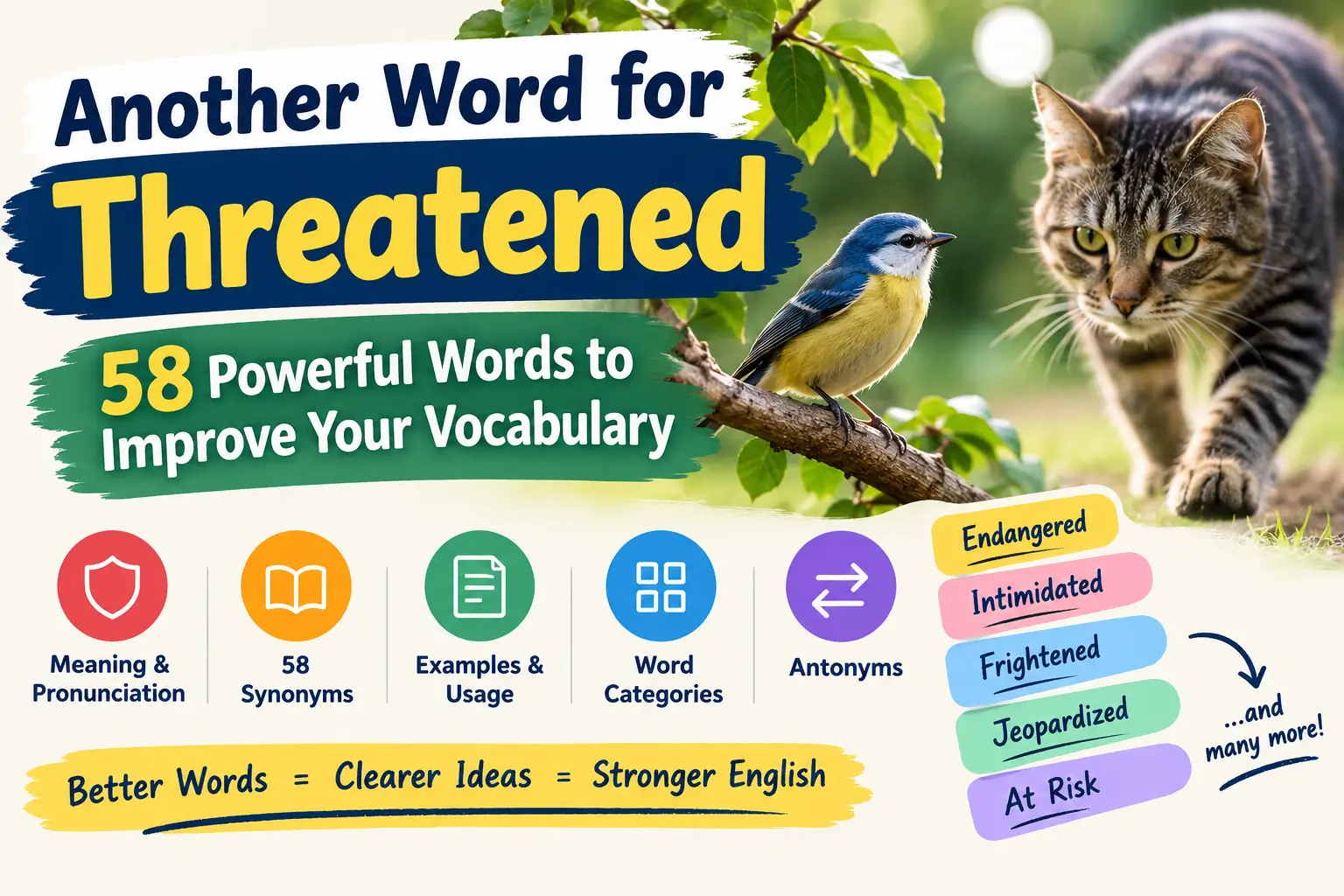
Another Word for Threatened 58 Powerful Words to Improve Your Vocabulary
The word threatened means that someone or something is in danger, faces harm, or may suffer a loss. Imagine a small bird sitting in a tree while a cat walks toward it. The bird is threatened because it may be attacked. The word can also describe a person who feels unsafe or fears losing a job, a home, or a place in society.
People often use threatened when talking about safety, wildlife, relationships, jobs, and personal feelings. Learning synonyms for this word helps English learners express ideas more clearly. It also helps writers avoid repeating the same word in every sentence.
In this guide, you will learn the meaning, pronunciation, history, grammar, and tone of threatened. You will also explore 58 synonyms, practical examples, word categories, and antonyms to help you choose the right word for each situation.
Meaning of Threatened
Definition
Threatened (adjective or verb): Describes someone or something that faces possible harm, danger, loss, or attack. As a verb, threatened is the past tense and past participle of threaten.
Examples
- The threatened bird flew away when the cat came closer.
- She felt threatened when a stranger followed her home.
- Rising sea levels have threatened many coastal communities.
- The manager threatened to end the contract if the rules were broken.
Connotative Meaning
(Connotation means the feelings or ideas that a word suggests beyond its basic meaning.)
- Positive tone: The word threatened rarely has a positive tone. However, a threatened person may receive support, protection, or help.
- Negative tone: It often suggests fear, danger, harm, pressure, or possible loss.
- Neutral tone: In reports about wildlife, business, or public safety, it can describe a risk without expressing a personal opinion.
Etymology
- Source language: The word comes from the verb threaten, which developed from Middle English threten.
- Earlier roots: The word is linked to Old English þreatian, meaning to threaten or press with threats.
- Original idea: Its early meaning focused on warning someone of harm or using fear to influence them.
- Modern meaning: Today, threatened can describe direct threats, possible danger, emotional pressure, and things at risk of being lost.
Short History of Threatened
Old English (450–1100): Related forms of the verb expressed the idea of threatening or putting pressure on someone. Written language during this period used different spelling conventions from modern English.
Middle English (1100–1500): The verb developed forms such as threten. It was used for warning people of harm, expressing hostile intent, or putting them under pressure.
Modern English (1500–present): The spelling and use of threaten became more stable. The past form threatened now describes both direct threats and situations in which people, animals, jobs, rights, or environments face danger.
Pronunciation
- US: /ˈθretənd/
- UK: /ˈθretənd/
Syllables
threat-ened — 2 syllables.
Affixation Pattern of Threatened
- Root/base: threaten
- Prefix: None.
- Suffix: -ed, which marks the past tense or past participle.
- Word formation: Threatened is formed by adding -ed to threaten. The final n remains, and the word ends with the sound /d/.
Words Formed From Threaten
- Threat (noun): A statement or situation that suggests possible harm.
- Threaten (verb): To say or show that harm may happen.
- Threatens (verb): The present-tense form used with he, she, or it.
- Threatened (verb/adjective): Faced a threat or being at risk.
- Threatening (verb/adjective): Making a threat or seeming dangerous.
- Threateningly (adverb): In a way that suggests harm.
- Threateningness (noun, rare): The quality of seeming threatening.
- Threat-free (adjective): Free from threats; a compound formed with threat and free.
Synonyms of Threatened
The best synonym for threatened depends on the situation. A person may feel intimidated, an animal may be endangered, and a job may be at risk. Some words describe fear, while others describe danger, pressure, or possible loss.
1. Endangered (Adjective)
US: /ɪnˈdeɪndʒərd/ | UK: /ɪnˈdeɪndʒəd/
Meaning: In danger of being harmed, lost, or destroyed.
Examples:
- The endangered tiger needs a safe place to live.
- Many endangered animals need protection from hunters.
2. Menaced (Adjective/Verb)
US: /ˈmenəst/ | UK: /ˈmenəst/
Meaning: Faced with a threat or danger from someone or something.
Examples:
- The small town was menaced by a large wildfire.
- Dark clouds menaced the village before the storm.
3. Intimidated (Adjective/Verb)
US: /ɪnˈtɪmɪˌdeɪtɪd/ | UK: /ɪnˈtɪmɪdeɪtɪd/
Meaning: Made to feel afraid or less confident because of another person’s actions or power.
Examples:
- He felt intimidated by the strict teacher.
- The new worker was not intimidated by the difficult task.
4. Frightened (Adjective/Verb)
US: /ˈfraɪtənd/ | UK: /ˈfraɪtənd/
Meaning: Made afraid or feeling fear because of possible danger.
Examples:
- The frightened child ran to her mother.
- I felt frightened when I heard a loud noise outside.
5. Scared (Adjective/Verb)
US: /skerd/ | UK: /skeəd/
Meaning: Feeling fear because something seems dangerous or harmful.
Examples:
- The scared dog hid under the table.
- She was scared that she might lose her home.
6. Alarmed (Adjective/Verb)
US: /əˈlɑrmd/ | UK: /əˈlɑːmd/
Meaning: Suddenly worried or afraid because of a possible danger.
Examples:
- Residents were alarmed by the smoke from the factory.
- The doctor was alarmed by the sudden change in his condition.
7. Menacing (Adjective)
US: /ˈmenəsɪŋ/ | UK: /ˈmenəsɪŋ/
Meaning: Seeming likely to cause harm or danger.
Examples:
- A menacing dog stood beside the gate.
- The sky looked menacing before the storm began.
8. Imperiled (Adjective/Verb)
US: /ɪmˈperəld/ | UK: /ɪmˈperəld/
Meaning: Put in danger or at risk of harm or loss.
Examples:
- The flood imperiled hundreds of homes.
- Poor planning imperiled the success of the project.
9. Jeopardized (Verb)
US: /ˈdʒepərˌdaɪzd/ | UK: /ˈdʒepədaɪzd/
Meaning: Put something important at risk.
Examples:
- His careless words jeopardized his friendship.
- The delay jeopardized the team’s chance of winning.
10. Endangering (Verb)
US: /ɪnˈdeɪndʒərɪŋ/ | UK: /ɪnˈdeɪndʒərɪŋ/
Meaning: Putting someone or something in danger.
Examples:
- Driving too fast is endangering other road users.
- Cutting down these trees is endangering local wildlife.
11. Vulnerable (Adjective)
US: /ˈvʌlnərəbəl/ | UK: /ˈvʌlnərəbəl/
Meaning: Easy to hurt, harm, attack, or affect.
Examples:
- Young birds are vulnerable to attacks from larger animals.
- Without savings, the family felt vulnerable during the crisis.
12. Exposed (Adjective/Verb)
US: /ɪkˈspoʊzd/ | UK: /ɪkˈspəʊzd/
Meaning: Left without enough protection from danger or harm.
Examples:
- The workers were exposed to dangerous chemicals.
- The broken fence left the garden exposed to animals.
13. Unprotected (Adjective)
US: /ˌʌnprəˈtektɪd/ | UK: /ˌʌnprəˈtektɪd/
Meaning: Not guarded or kept safe from harm.
Examples:
- The unprotected windows broke during the storm.
- The young plants remained unprotected from the cold.
14. Unsafe (Adjective)
US: /ʌnˈseɪf/ | UK: /ʌnˈseɪf/
Meaning: Not safe from possible harm or danger.
Examples:
- The old bridge was unsafe for heavy trucks.
- She left the building because the air felt unsafe to breathe.
15. At Risk (Adjective Phrase)
US: /æt rɪsk/ | UK: /æt rɪsk/
Meaning: In a situation where harm, loss, or failure may happen.
Examples:
- Several homes are at risk of flooding.
- The company is at risk of losing its biggest client.
16. In Danger (Adjective Phrase)
US: /ɪn ˈdeɪndʒər/ | UK: /ɪn ˈdeɪndʒə/
Meaning: In a situation where harm may occur.
Examples:
- The hikers were in danger during the snowstorm.
- The old building is in danger of falling down.
17. Threatened (Adjective)
US: /ˈθretənd/ | UK: /ˈθretənd/
Meaning: Facing a possible threat, attack, or loss.
Examples:
- The threatened community asked for extra security.
- The threatened species received legal protection.
18. Pressured (Adjective/Verb)
US: /ˈpreʃərd/ | UK: /ˈpreʃəd/
Meaning: Made to feel that one must do something because of demands or force.
Examples:
- She felt pressured to accept the offer.
- The players were pressured by the opposing team.
19. Coerced (Adjective/Verb)
US: /koʊˈɜrsɪd/ | UK: /kəʊˈɜːsɪd/
Meaning: Forced to do something through threats, pressure, or force.
Examples:
- He claimed that he was coerced into signing the paper.
- No worker should be coerced into breaking the law.
20. Bullied (Adjective/Verb)
US: /ˈbʊlid/ | UK: /ˈbʊlid/
Meaning: Hurt, frightened, or controlled by someone who uses power to mistreat others.
Examples:
- The student felt bullied by a group of older children.
- Nobody should be bullied for asking a question.
21. Harassed (Adjective/Verb)
US: /həˈræst/ | UK: /ˈhærəst/
Meaning: Repeatedly bothered, abused, or pressured in a harmful way.
Examples:
- The worker felt harassed by repeated unwanted calls.
- She reported being harassed by a former neighbor.
22. Oppressed (Adjective/Verb)
US: /əˈprest/ | UK: /əˈprest/
Meaning: Kept under unfair control or treated cruelly by people with power.
Examples:
- The oppressed group called for equal rights.
- Many people fought against the system that oppressed them.
23. Cornered (Adjective/Verb)
US: /ˈkɔrnərd/ | UK: /ˈkɔːnəd/
Meaning: Trapped in a place or situation with few ways to escape.
Examples:
- The cornered animal searched for a way out.
- During the debate, he felt cornered by difficult questions.
24. Trapped (Adjective/Verb)
US: /træpt/ | UK: /træpt/
Meaning: Unable to escape from a place or difficult situation.
Examples:
- The trapped hikers waited for the rescue team.
- She felt trapped in a job she did not enjoy.
25. Besieged (Adjective/Verb)
US: /bɪˈsidʒd/ | UK: /bɪˈsiːdʒd/
Meaning: Surrounded by attackers or overwhelmed by many demands and problems.
Examples:
- The besieged city struggled to receive food.
- The help desk was besieged by calls after the outage.
26. Hounded (Adjective/Verb)
US: /ˈhaʊndɪd/ | UK: /ˈhaʊndɪd/
Meaning: Followed, bothered, or pressured again and again.
Examples:
- The reporter hounded the actor with questions.
- She felt hounded by debt collectors.
27. Pursued (Verb)
US: /pərˈsud/ | UK: /pəˈsjuːd/
Meaning: Followed or chased someone or something, sometimes with harmful intent.
Examples:
- The fleeing deer was pursued by a wolf.
- He felt threatened when strangers pursued him down the street.
28. Chased (Verb)
US: /tʃeɪst/ | UK: /tʃeɪst/
Meaning: Followed quickly to catch or reach someone or something.
Examples:
- The frightened rabbit was chased by a dog.
- The thief was chased through the market.
29. Attacked (Adjective/Verb)
US: /əˈtækt/ | UK: /əˈtækt/
Meaning: Targeted with physical force, harmful words, or other hostile actions.
Examples:
- The attacked village needed urgent help.
- She felt attacked when her ideas were mocked.
30. Targeted (Adjective/Verb)
US: /ˈtɑrɡɪtɪd/ | UK: /ˈtɑːɡɪtɪd/
Meaning: Chosen as the person or thing toward which an attack or action is directed.
Examples:
- The targeted website faced several cyberattacks.
- He felt targeted by unfair rules at work.
31. Beset (Verb)
US: /bɪˈset/ | UK: /bɪˈset/
Meaning: Surrounded or troubled by many problems or dangers.
Examples:
- The town was beset by floods and power cuts.
- The project was beset by delays from the start.
32. Plagued (Adjective/Verb)
US: /pleɪɡd/ | UK: /pleɪɡd/
Meaning: Troubled by repeated problems or difficulties.
Examples:
- The farm was plagued by pests.
- The team was plagued by injuries throughout the season.
33. Haunted (Adjective/Verb)
US: /ˈhɔntɪd/ | UK: /ˈhɔːntɪd/
Meaning: Troubled by a lasting fear, memory, or worry.
Examples:
- He was haunted by memories of the accident.
- She felt haunted by the fear of losing her home.
34. Distressed (Adjective/Verb)
US: /dɪˈstrest/ | UK: /dɪˈstrest/
Meaning: Feeling great worry, sadness, or pain.
Examples:
- The distressed family asked for help.
- He became distressed when he heard the news.
35. Worried (Adjective/Verb)
US: /ˈwɜrid/ | UK: /ˈwʌrid/
Meaning: Feeling uneasy because something bad may happen.
Examples:
- She was worried about losing her job.
- The parents were worried about their child’s safety.
36. Fearful (Adjective)
US: /ˈfɪrfəl/ | UK: /ˈfɪəfəl/
Meaning: Feeling or showing fear about possible danger.
Examples:
- The fearful child held his father’s hand.
- Residents grew fearful as the fire spread.
37. Apprehensive (Adjective)
US: /ˌæprɪˈhensɪv/ | UK: /ˌæprɪˈhensɪv/
Meaning: Worried or uneasy about what may happen.
Examples:
- She felt apprehensive before the difficult meeting.
- The family was apprehensive about moving to a new city.
38. Anxious (Adjective)
US: /ˈæŋkʃəs/ | UK: /ˈæŋkʃəs/
Meaning: Feeling worried or nervous about a possible problem.
Examples:
- He felt anxious when the storm grew stronger.
- The workers were anxious about the future of their jobs.
39. Nervous (Adjective)
US: /ˈnɜrvəs/ | UK: /ˈnɜːvəs/
Meaning: Worried or uneasy because of uncertainty or fear.
Examples:
- The nervous passenger asked about the safety rules.
- She felt nervous when someone followed her at night.
40. Uneasy (Adjective)
US: /ʌnˈiːzi/ | UK: /ʌnˈiːzi/
Meaning: Feeling uncomfortable or worried that something may be wrong.
Examples:
- He felt uneasy about the stranger’s behavior.
- The quiet streets made her uneasy after dark.
41. Daunted (Adjective/Verb)
US: /ˈdɔntɪd/ | UK: /ˈdɔːntɪd/
Meaning: Made to feel less confident because something seems difficult or frightening.
Examples:
- She was not daunted by the hard exam.
- The new challenge daunted the inexperienced team.
42. Overwhelmed (Adjective/Verb)
US: /ˌoʊvərˈwelmd/ | UK: /ˌəʊvəˈwelmd/
Meaning: Unable to cope easily with strong feelings, demands, or problems.
Examples:
- The family felt overwhelmed by the sudden crisis.
- He was overwhelmed by the number of complaints.
43. Opposed (Adjective/Verb)
US: /əˈpoʊzd/ | UK: /əˈpəʊzd/
Meaning: Facing resistance or disagreement from someone.
Examples:
- The threatened plan was opposed by local residents.
- She felt opposed by people who rejected every suggestion.
44. Challenged (Adjective/Verb)
US: /ˈtʃælɪndʒd/ | UK: /ˈtʃælɪndʒd/
Meaning: Questioned, tested, or faced with resistance or difficulty.
Examples:
- The leader felt challenged by the team’s questions.
- The old policy was challenged in court.
45. Confronted (Adjective/Verb)
US: /kənˈfrʌntɪd/ | UK: /kənˈfrʌntɪd/
Meaning: Faced directly with a person, problem, or difficult situation.
Examples:
- She felt threatened when confronted by an angry stranger.
- The town was confronted with a serious water shortage.
46. Pressed (Adjective/Verb)
US: /prest/ | UK: /prest/
Meaning: Put under pressure or urged strongly to act.
Examples:
- The team was pressed to finish the work by Friday.
- He felt pressed to make a quick decision.
47. Compelled (Adjective/Verb)
US: /kəmˈpeld/ | UK: /kəmˈpeld/
Meaning: Forced or strongly driven to do something.
Examples:
- She felt compelled to leave the unsafe area.
- The witness was compelled to answer questions in court.
48. Forced (Adjective/Verb)
US: /fɔrst/ | UK: /fɔːst/
Meaning: Made to do something against one’s wishes.
Examples:
- The family was forced to leave after the flood.
- He felt forced to agree with the manager.
49. Blackmailed (Adjective/Verb)
US: /ˈblækˌmeɪld/ | UK: /ˈblækmeɪld/
Meaning: Threatened with exposure or harm to make someone do something or give something.
Examples:
- The businessman was blackmailed by a former partner.
- She reported being blackmailed over private messages.
50. Extorted (Verb)
US: /ɪkˈstɔrtɪd/ | UK: /ɪkˈstɔːtɪd/
Meaning: Obtained money or something else through threats or force.
Examples:
- The criminals extorted money from local shop owners.
- He was extorted by people who threatened to reveal his secret.
51. Bullied Into (Verb Phrase)
US: /ˈbʊlid ˈɪntuː/ | UK: /ˈbʊlid ˈɪntuː/
Meaning: Pressured through bullying to do something unwillingly.
Examples:
- She was bullied into giving away her lunch.
- He was bullied into accepting an unfair deal.
52. Under Threat (Adjective Phrase)
US: /ˈʌndər θret/ | UK: /ˈʌndə θret/
Meaning: Facing a stated or possible danger, attack, or loss.
Examples:
- The historic building is under threat from demolition.
- The workers’ jobs were under threat after the merger.
53. Insecure (Adjective)
US: /ˌɪnsɪˈkjʊr/ | UK: /ˌɪnsɪˈkjʊə/
Meaning: Lacking a feeling of safety, confidence, or stability.
Examples:
- He felt insecure about his place on the team.
- The unstable walls made the building insecure.
54. Precarious (Adjective)
US: /prɪˈkeriəs/ | UK: /prɪˈkeəriəs/
Meaning: Uncertain or unsafe, with a real chance of failure or harm.
Examples:
- The workers were in a precarious position during the rescue.
- Her job became precarious after the company lost money.
55. Periled (Verb)
US: /ˈperəld/ | UK: /ˈperəld/
Meaning: Put in danger or exposed to possible harm.
Examples:
- The storm periled ships near the coast.
- The careless decision periled the future of the business.
56. Menaced by (Adjective Phrase)
US: /ˈmenəst baɪ/ | UK: /ˈmenəst baɪ/
Meaning: Facing danger from a person, animal, event, or force.
Examples:
- The village was menaced by a spreading wildfire.
- The small boat was menaced by huge waves.
57. Under Attack (Adjective Phrase)
US: /ˌʌndər əˈtæk/ | UK: /ˌʌndər əˈtæk/
Meaning: Being targeted by physical, verbal, digital, or other hostile actions.
Examples:
- The website was under attack from hackers.
- She felt under attack when her colleagues blamed her.
58. At Stake (Adjective Phrase)
US: /æt steɪk/ | UK: /æt steɪk/
Meaning: At risk of being lost, damaged, or affected by an important decision.
Examples:
- The future of the wildlife reserve was at stake.
- His reputation was at stake during the public hearing.
Prototype Meaning of Threatened
The most typical meaning of threatened is being in danger of harm, attack, or loss. When people hear this word, they often imagine someone facing a frightening situation, an animal in danger, or a person receiving a warning of harm.
However, the word can also describe a feeling of fear or a situation that may become unsafe. Its exact meaning depends on the context. For example, a threatened animal needs protection, while a person who feels threatened may need safety or support.
Prototype Categorization
Grouping synonyms by meaning helps writers choose words that fit the situation. Not every synonym can replace threatened in every sentence.
- Physical danger: Endangered, imperiled, unsafe, exposed, unprotected, in danger, and under attack. Use these words when someone or something faces possible physical harm.
- Fear and worry: Frightened, scared, alarmed, fearful, anxious, nervous, uneasy, and apprehensive. These words focus on emotional responses to possible danger.
- Pressure and control: Intimidated, pressured, coerced, bullied, harassed, oppressed, compelled, and forced. Use them when someone feels pushed or controlled by another person.
- Being trapped or pursued: Cornered, trapped, besieged, hounded, pursued, and chased. These words describe situations where escape or freedom may be limited.
- Risk of loss or failure: Jeopardized, at risk, at stake, precarious, imperiled, and under threat. These terms work well in business, environmental, legal, and everyday writing.
- Hostile actions: Menaced, attacked, targeted, blackmailed, and extorted. These words describe specific forms of danger or harmful behavior.
- Ongoing trouble: Beset, plagued, haunted, distressed, and overwhelmed. These words describe repeated problems or lasting emotional pressure.
- Resistance and conflict: Opposed, challenged, confronted, and pressed. Use them when a person faces resistance, difficult demands, or disagreement.
Understanding these categories helps you select a precise word instead of repeating threatened. It also helps you avoid using a word that changes the original meaning.
Antonyms of Threatened
Antonyms are words with opposite or contrasting meanings. The best opposite of threatened depends on whether you mean physical safety, emotional confidence, or freedom from pressure.
- Safe (adjective): Protected from harm or danger.
- Protected (adjective): Kept safe from injury, damage, or attack.
- Secure (adjective): Safe, stable, and free from serious danger.
- Unthreatened (adjective): Not facing a threat or feeling threatened.
- Fearless (adjective): Not afraid of danger or difficulty.
- Confident (adjective): Feeling sure of yourself or your abilities.
- Calm (adjective): Peaceful and free from strong worry or fear.
- Reassured (adjective/verb): Made to feel less worried or afraid.
- Defended (adjective/verb): Protected against an attack or accusation.
- Sheltered (adjective/verb): Protected from danger, harm, or harsh conditions.
- Guarded (adjective): Kept safe or protected from possible harm.
- Comfortable (adjective): Feeling relaxed, safe, or at ease.
- Unharmed (adjective): Not injured or damaged.
- Empowered (adjective/verb): Given the confidence, authority, or ability to act.
- Free (adjective): Not controlled, trapped, or forced by another person.
Short Questions and Answers
What does threatened mean?
Threatened means facing possible harm, danger, attack, or loss. It can also describe someone who feels afraid or unsafe.
When should threatened be used?
Use threatened when a person, animal, place, job, or other important thing faces a possible danger or loss. It can also describe someone who feels intimidated by another person.
Is threatened positive or negative?
It usually has a negative tone because it suggests fear, danger, or possible harm. However, it can appear in neutral reports, such as reports about threatened wildlife.
How is threatened different from similar words?
Endangered usually focuses on serious risk, especially to animals or the environment. Intimidated focuses on fear caused by another person’s behavior. Jeopardized emphasizes the risk of losing something important. Threatened is broader and can refer to danger, warnings, or feelings of fear.
What is the difference between threatened and threatening?
Threatened describes someone or something facing a threat. Threatening describes someone or something that seems likely to cause harm or is making a threat.
Can threatened be used as a verb?
Yes. It is the past tense and past participle of threaten. For example, “The stranger threatened the shopkeeper.”
What is a simple synonym for threatened?
At risk is a simple alternative when something may be harmed or lost. Scared is more suitable when describing a person’s feelings.
What is the opposite of threatened?
Safe, protected, and unthreatened are common opposites. The best choice depends on the sentence.
Conclusion
Learning the meaning of threatened and its synonyms can improve your English vocabulary and help you express ideas more clearly. Words such as endangered, intimidated, frightened, and jeopardized describe different types of danger, fear, and risk. Choosing the right word makes your writing more precise and your speech more natural.
Understanding pronunciation, word history, grammar, and connotation also helps you use new vocabulary with confidence.
Rather than memorizing all 58 alternatives at once, learn a few words each day. Write simple sentences, read examples aloud, and practice using each word in a real situation. Over time, this habit will help you avoid repetition, strengthen your writing and speaking skills, and build greater confidence in English.

Michael Bennett is a vocabulary coach and educational writer who explains English words in simple, practical language. His work focuses on useful synonyms, everyday expressions, word choice, and clear examples that help readers expand their vocabulary without making English unnecessarily complicated.